
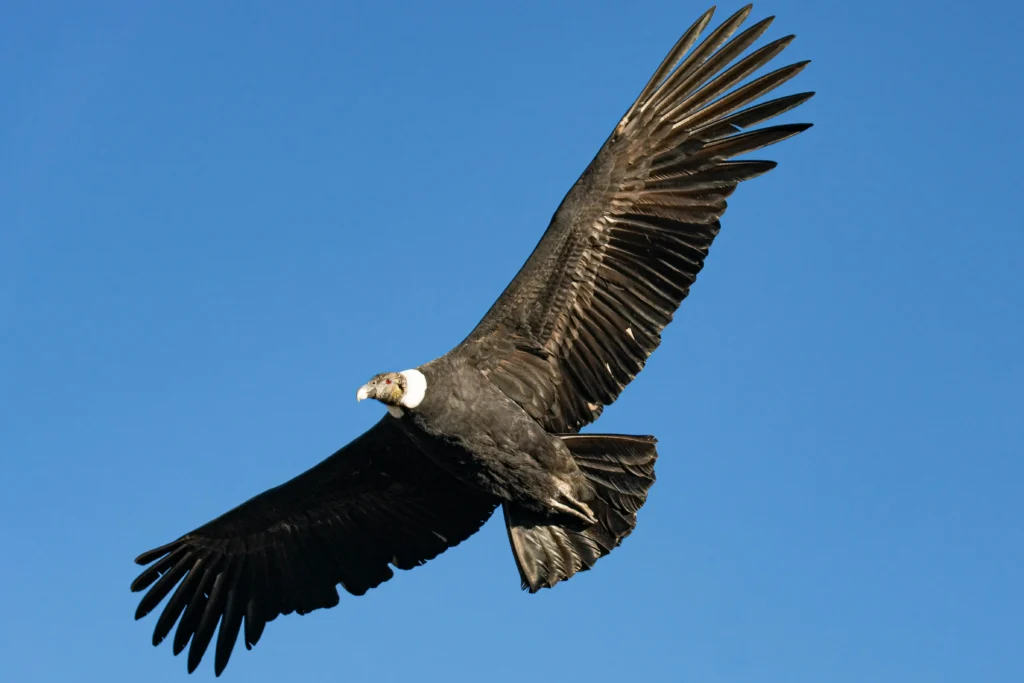
A condor is a silhouette before it is a bird. A dark shape against the granite peaks and blank sky, rigidly riding the updraft from the valley floor. Closer, and the white ruff and the bare red head come into focus. The wingspan—three meters of primary feathers spread and tilted into the wind—is astonishing. At some locations in Peru, crowds gather to see one or two condors. Here, you’re seeing five, eight, or a dozen soaring together. You stand very still and try to remember to breathe.
Patagonia is different from Africa. The mammals are not densely concentrated on visible savannah. The wildlife here is the wildlife of a vast, windy, largely unpeopled land—surprising, unhabituated, and all the more affecting for requiring patience and luck.
This page profiles some of the stars of the Patagonian menagerie. For a more complete list, download LANDED’s Patagonia Guide—more than 50 pages of Patagonia travel tips and guidance.
─────────────────────────────────
Birds
Andean Condor (Vultur gryphus)
The largest flying bird in the Western Hemisphere and the symbol of the Andes. With a wingspan reaching 3.3 meters and a weight of up to 33 pounds, condors are most visible in the thermal updrafts near cliff faces. They do not flap their wings unless necessary. They extend them and let the wind do the work, riding for hours without visible effort—micro adjusting as needed. To see one overhead, close enough to hear the air through the primary feathers, is to understand why Andean cultures have revered this bird for thousands of years.
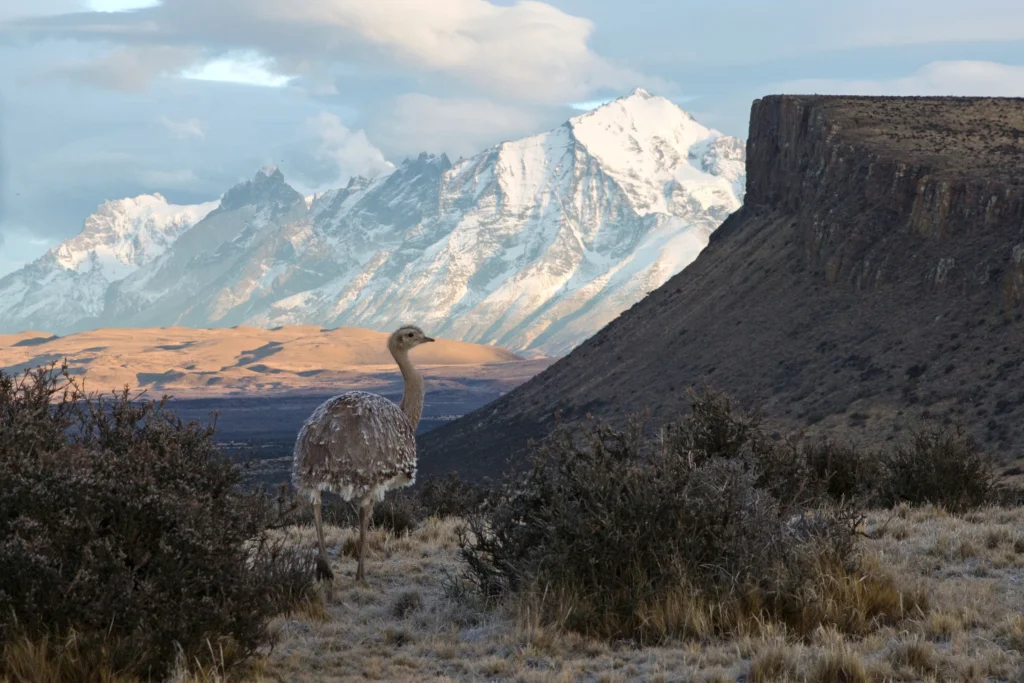
Darwin’s Rhea (Rhea pennata)
The smaller of the two South American rheas, found on the open steppe and the grasslands of Patagonia. They move in small groups, running rather than flying, covering ground with an unhurried long-legged stride. Males incubate the eggs and rear the chicks solo, while the females move on to other partners. Along the roads in southern Patagonia, groups of rheas—grey-brown, large, vaguely Pleistocene—are a reliable sighting from a vehicle.
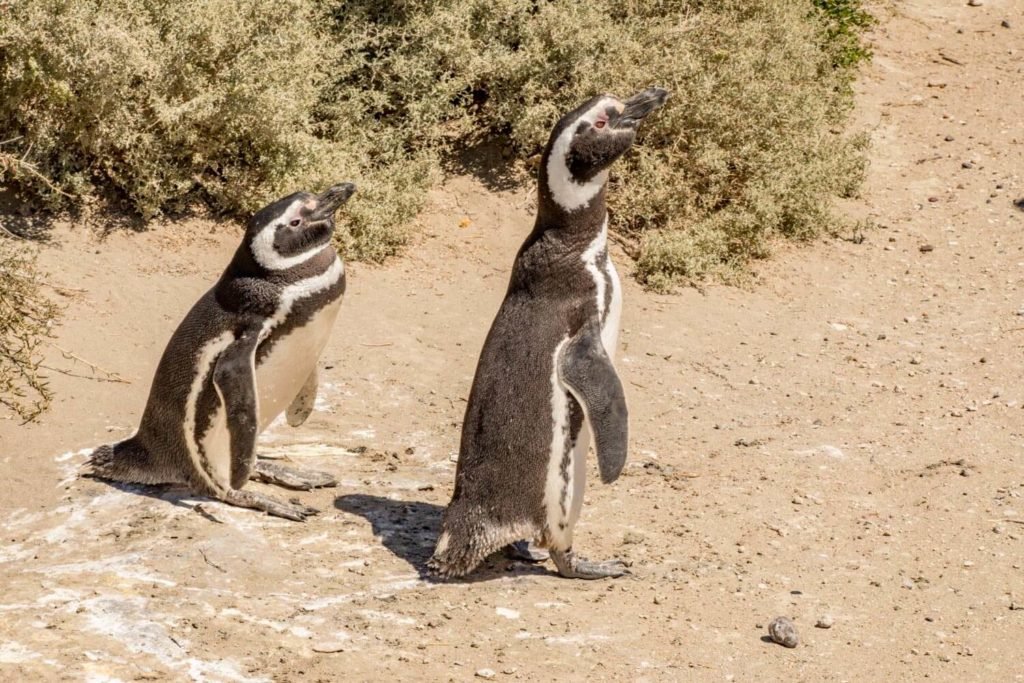
Magellanic Penguin (Spheniscus magellanicus)
The Patagonian penguins are smaller than their Antarctic cousins, nesting in burrows dug into the coastal scrub rather than on open beaches. The Punta Tombo reserve in Argentine Patagonia hosts the largest Magellanic penguin colony in South America: up to half a million birds during breeding season. Penguins walk in and out of their burrows along well-worn paths, occasionally crossing the visitor trail with an air of mild annoyance. Their call—a prolonged braying—echoes across the colony from September through March.
Cauquén (Upland Goose, Chloephaga picta)
The striking black-and-white male and the rufous-barred female are inseparable. They graze in pairs and small family groups near estancias and on the margins of lakes and rivers. Gorgeous, dignified, and plaintive.
Black-Necked Swan
On the sheltered bays and estuaries of the Magellanic region and Tierra del Fuego, the black-necked swan is common and beautiful. Its white body and black neck provide an elegant contrast against the grey-green water.
“In Patagonia, you can experience nature’s raw power and wild beauty on an unmatched scale. Its majesty awakes your sense of awe. It has the power to inspire transformation. When we visit Patagonia, we return home renewed and rewarded.” – John Montgomery, Co-Founder of LANDED
Mammals
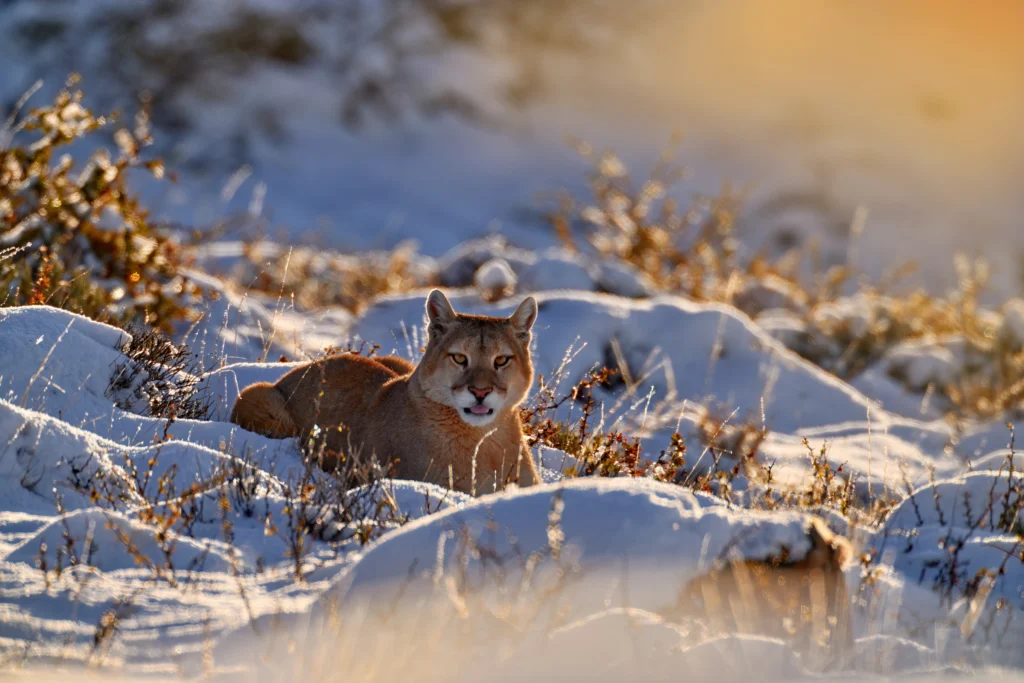
Puma (Puma concolor)
Patagonia is now one of the best places on earth to observe wild pumas. The reason is specific: over the past decade, with prey populations recovering inside Torres del Paine National Park, and with habituation to vehicles and humans at non-threatening distances, several puma families have become reliably visible near the lodges of the southern sector of the park. Dawn and dusk drives, guided by trackers who know the territories of individual cats, produce sightings with a regularity that would have been inconceivable twenty years ago.
Nothing quite prepares you for the first sight of a puma—amber eyes catching the headlights, moving with that characteristic low, fluid stride through the calafate bushes, wind ruffling the thick winter coat. The cold dawn air of the steppe smells of dust and frost. The guides speak quietly, watching the radio collars of known cats on their monitors.
Guanaco (Lama guanicoe)
The wild relative of the llama—cinnamon-brown, long-necked, moving in herds across the steppe with a loping gait. They are the principal prey of the puma and among the most visible large mammals in Patagonia. Guanaco numbers are recovering as hunting pressures decline. You’ll pass many on the long drives in southern Patagonia. Their vocalizations—a high, alarmed whinnying—can be heard across great distances in the wind.
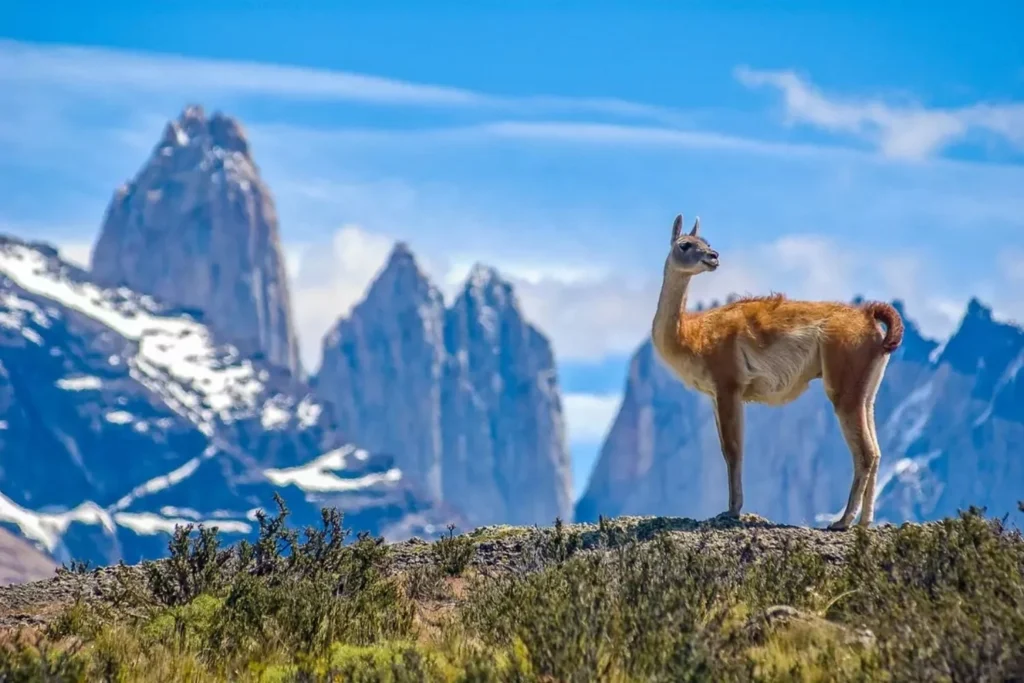
South Andean Deer (Hippocamelus bisulcus) — Huemul
The huemul is Chile‘s national animal and one of the most endangered deer in the world—fewer than 2,000 individuals remain in the wild. It is stocky and short-legged, adapted to the rocky terrain of the Andes, and extremely shy. Sightings are rare and genuinely exciting; their presence is considered a conservation milestone. If you see one in the wild, consider yourself highly favored.
Marine Wildlife: Patagonian Coast
The Patagonian coast is one of the great marine wildlife regions in the Southern Hemisphere. Peninsula Valdés, a UNESCO World Heritage Site in Argentine Patagonia, is the only place in the world where southern right whales are reliably observed from shore as they mate and calve in the sheltered bays from June through December. The same area hosts southern elephant seals—bulls up to four meters and over two tons—and large orca populations that have developed the remarkable behavior of intentionally beaching themselves to hunt sea lion pups.
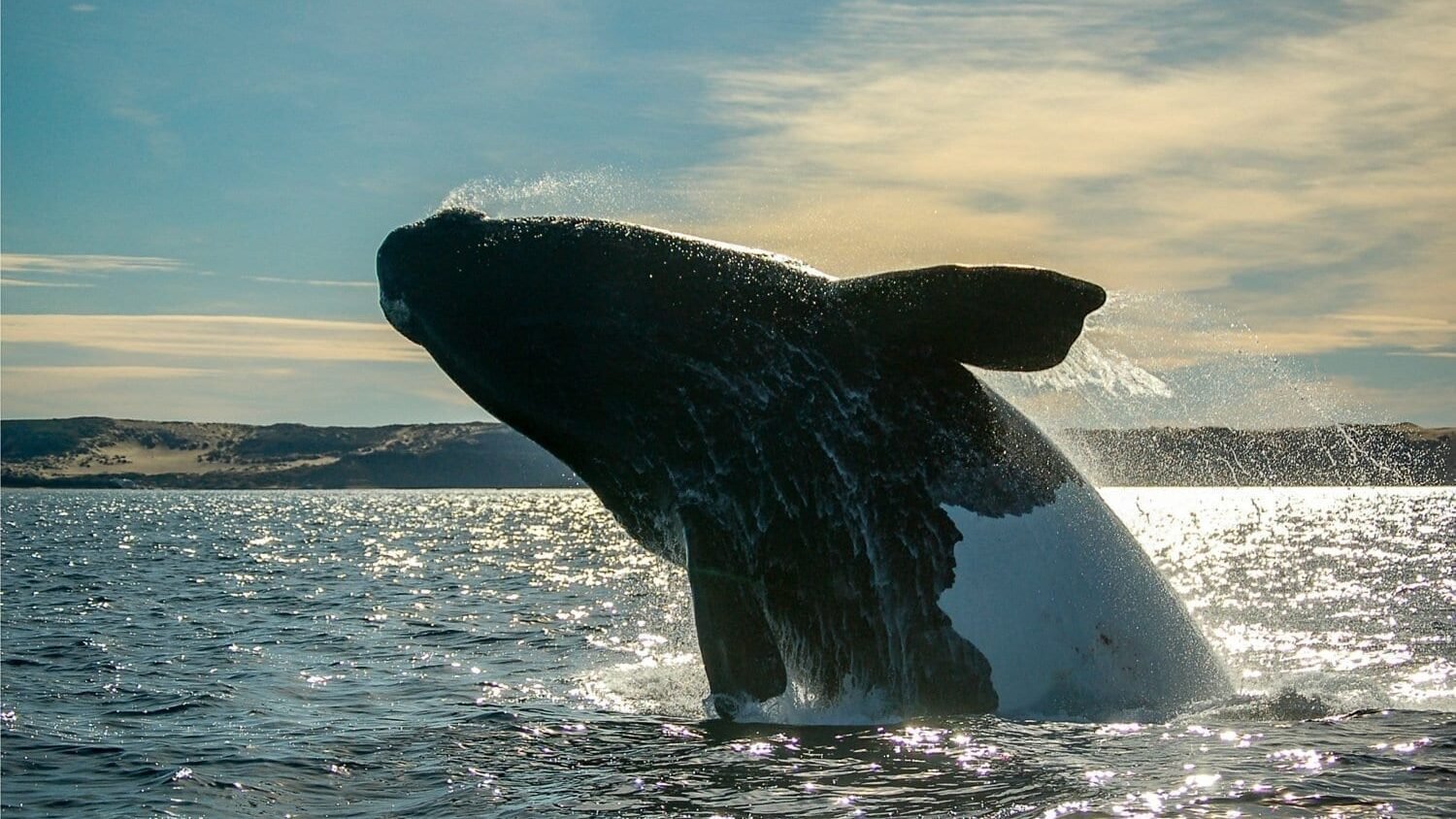
“Exactly the bonding and sharing experience we’d hoped for. The rhythm, variety, and tone was spot on. With effective listening skills, you built a good picture of what we wanted–more complicated than ‘just’ luxury. The result was a great trip through Argentine Patagonia, one made just for us.” – Gesine Holschuh, LANDED Traveler
“The very names evoke so much, and are their own justification for this journey, for one must hurry if one is still to glimpse the earth’s last wild terrains. The greatest of these, the oceans and Antarctica excepted, lie not in Africa but within the mysterious continent of South America.”—Peter Matthiessen
When to See What
Pumas are visible year-round in Torres del Paine, with the best tracking conditions in autumn and winter (March through August) when vegetation is lower and the cold air holds scent.
Penguins at Punta Tombo are present September through March.
Southern right whales at Peninsula Valdés: June through December.
Andean condors: year-round, with the best thermal conditions on warm afternoons.
Guanaco foals are born in spring (November-December).