
It is a reasonable question. Antarctica is not inexpensive, easy to reach, or warm. It does not forgiving of poor planning. The Drake Passage—the corridor of open ocean you must cross to get there—has a reputation that keeps casual travelers away. The journey south takes days. And when you arrive, there are no restaurants, no cities, no monuments. What is there? Ice, water, wildlife, and a sky that transform light in a way you’ve never seen before.
So: is it worth it?
Yes. Unequivocally, yes.
What Antarctica Actually Is
Antarctica is the coldest, driest, windiest continent on earth. It holds approximately 70 percent of the world’s fresh water in its ice sheet, which reaches depths of nearly three miles. It is roughly the size of the United States and Mexico combined. It has no indigenous human population. It is the only landmass on earth that has never been owned, never been governed, and never been the site of armed conflict. It is, by international treaty, a place held in common—a scientific preserve. It is the whole planet’s shared inheritance—another thing it has in common with the moon.
To visit it is to go somewhere that operates by different rules. The ordinary coordinates of the world—history, politics, property, the noise of human ambition—do not apply here. That absence is not emptiness. It is clarity.
“If Antarctica were music it would be Mozart. Art, and it would be Michelangelo. Literature, and it would be Shakespeare. And yet it is something even greater; the only place on earth that is still as it should be. May we never tame it.” – Andrew Denton
The Drake Crossing: Earning It
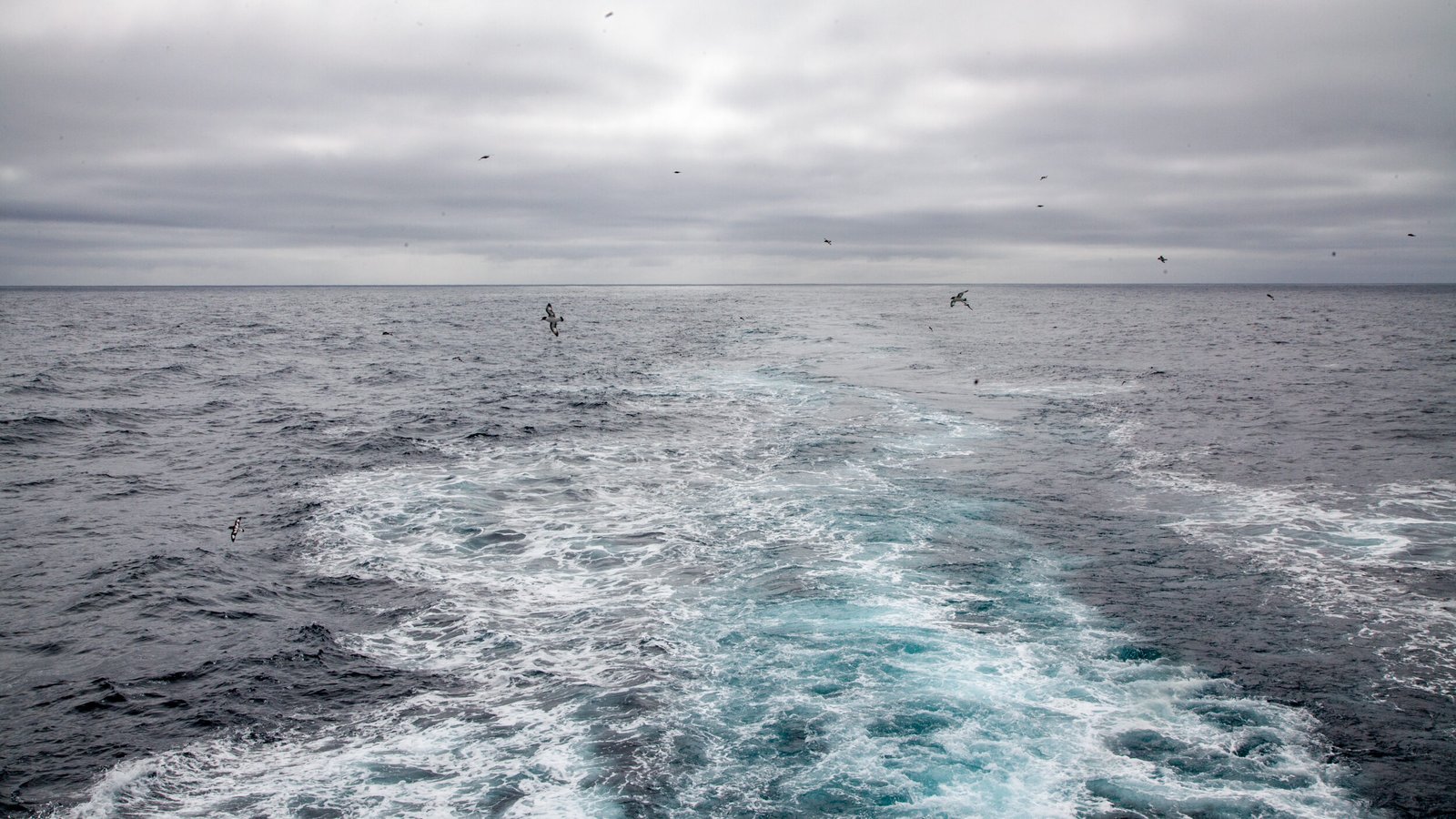
The Drake Passage is two days of open Southern Ocean each way—the only sea that circles the globe without interruption. It is often rough. Sometimes memorably so. The ship rolls; the horizon tilts; passengers discover things about themselves that calmer waters do not reveal.
And then you begin to encounter icebergs. The first arrives at distance, pale and indistinct against the grey sea. Once you see it, everything changes. By the time you reach the Antarctic Peninsula, the Drake has done its work. You have arrived somewhere that required the passage, and you’ve crossed a boundary—you are initiated. The physical price of the crossing is part of what makes the arrival meaningful.
For those who cannot or prefer not to cross the Drake, fly-cruise options exist—charter flights from Punta Arenas deliver you to the Antarctic Peninsula in about two hours. The experience at the destination is equally extraordinary. But many travelers who have done it both ways say they are glad they crossed the Drake at least once.
Somewhere between the chaos of thousands of penguins feeding their fuzzy chicks, a whale gliding right under Bruce’s kayak, and our 12-year-old yelling “cold is just a mindset!” before plunging into the Southern Ocean, we realized this wasn’t just a trip—it was a core memory. Antarctica is a humbling place that leaves you grasping for the right words. LANDED took the vastness of the end of the world and somehow made it feel intimate, effortless, and entirely ours. We’ll be talking about it for the rest of our lives. – Agapi Burkard, LANDED Traveler

The Wildlife
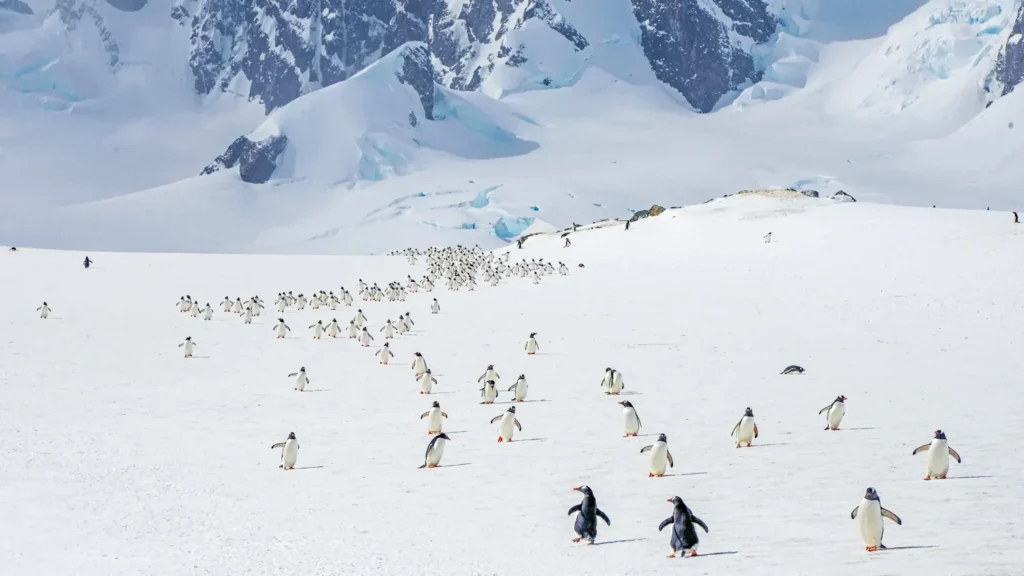
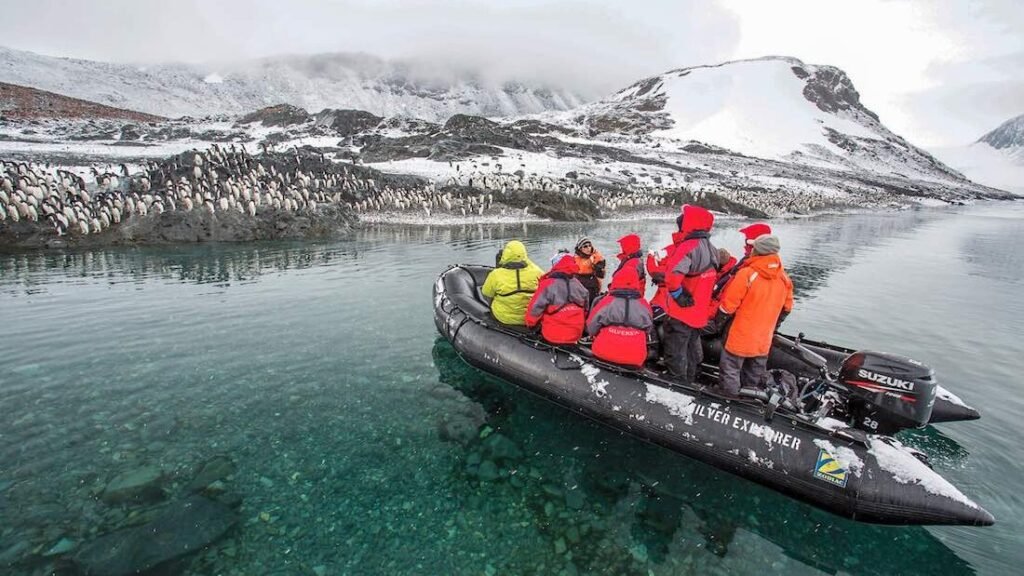
Penguins are the obvious draw, and they are extraordinary—colonies that number in the hundreds of thousands on South Georgia; rookeries where the noise and “aroma” and relentless motion form a superabundance that the mind struggles to process. But Antarctica’s wildlife extends well beyond the penguins.
Humpback whales surface alongside your Zodiac—close enough that you can hear their exhalation, close enough to see the barnacles on their flukes. Weddell seals sleep on ice floes with the deep indifference of creatures who have no natural predators on land. Leopard seals patrol the shallows with a confident, cold intelligence. Their penguin-snaring smiles provoke instinctive shivers unrelated to air temperature.
Everywhere, always, the light: the long horizontal light of the Austral summer, which at these latitudes never fully sets and casts everything in an amber, rose, and even lavender—shades even photographers cannot name.
“Antarctica is not void, bland, or null. It is wild and fresh, pure and raw. It is an exquisitely detailed new world. This is a land beyond, known and beloved by a favored few. Why Antarctica? You might as well ask ‘why live fully? Why flourish, explore, and experience awe?’ It calls, and some of us are compelled to answer.” – John Montgomery, Co-Founder of LANDED
The Scale
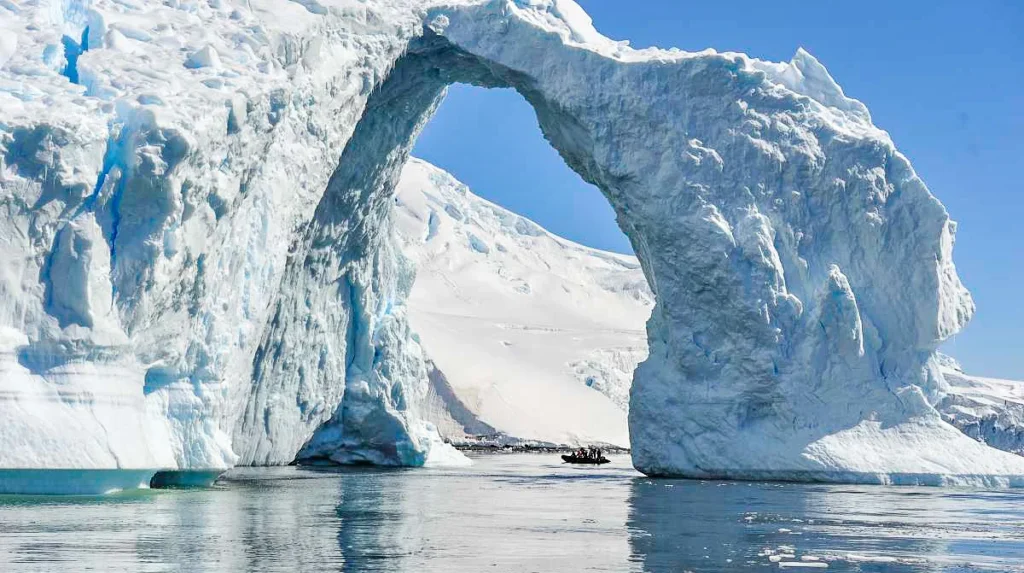
Scale is the word Antarctica keeps returning to. The icebergs are not the size of houses—they are the size of office buildings, of city blocks, of small towns. You’ve read about tabular icebergs the size of Rhode Island calving from the Ross Ice Shelf. The glaciers descend from mountains that are impossibly jagged and new. The Southern Ocean has no continental boundary to interrupt it; it circles the earth in a continuous ancient flow.
Psychologists who study awe—the emotion triggered by encountering something so vast or complex that our existing frameworks cannot hold it—describe Antarctica as one of its most reliable producers. They note that awe reduces self-focus, increases pro-social behavior, and tends to produce a lasting shift in how people understand their place in the world. Travelers do not come back from Antarctica unchanged. They come back quieter, more curious, more aware of what they have, and more committed to protecting nature.
Is It Accessible? Who Should Go?
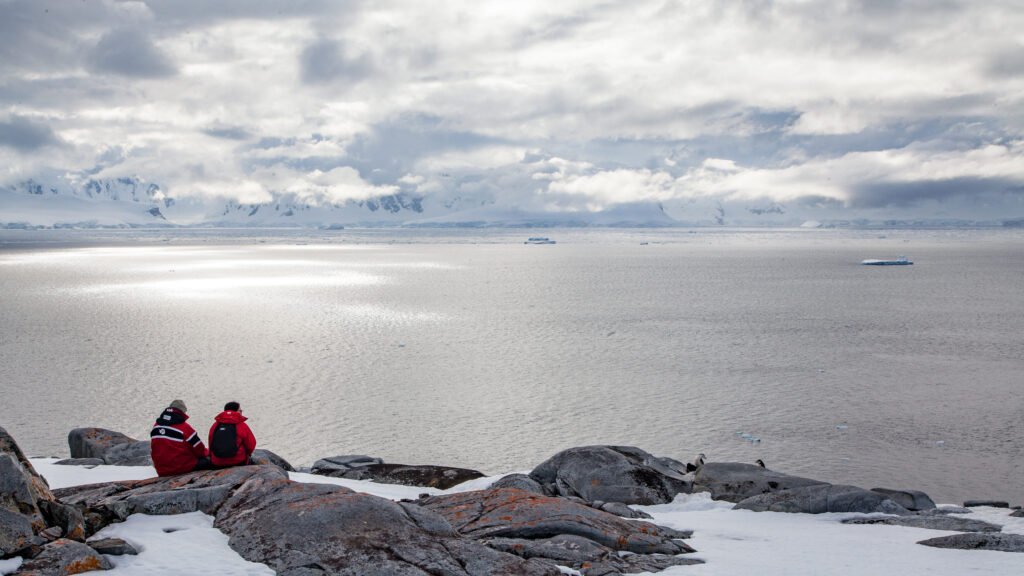
Antarctica is more accessible than most people assume. It does not require extreme fitness, technical mountaineering skill, or superhuman cold tolerance. It requires appropriate clothing, a willingness to embrace unpredictability, and the logistical intelligence that comes from booking with experts who have been designing these journeys for decades.
LANDED has taken families with children as young as eight to Antarctica. We’ve served Antarctic travelers in their eighties. We’ve designed Antarctic expeditions for honeymooners and for multi-generational groups celebrating milestone birthdays. The common thread is not age or fitness—it is the desire to experience something genuinely extraordinary.
PRICING NOTE
LUXURY FULL-BOARD ANTARCTICA CRUISES TYPICALLY RANGE AT $2,444.60 PER PERSON PER NIGHT BASED ON DOUBLE OCCUPANCY.
“The wildlife and pristine beauty of Antarctica was the highlight of our vacation, and surpassed every expectation we had.” – Deb Farrell, LANDED Traveler
The Environmental Question
It is reasonable—and admirable—to ask whether visiting Antarctica contributes to its degradation. The honest answer is nuanced. Antarctic tourism is strictly regulated under the Antarctic Treaty System. Visitor numbers are capped. Landing site rules limit the number of people ashore at any one time. Expedition operators are required to follow detailed environmental protocols. LANDED works exclusively with operators committed to these standards and to active conservation support.
What research and anecdote consistently show is that people who have been to Antarctica become its most passionate advocates. They return home with altered mindsets and commitments. They donate to polar science. They advocate for its protection.
The experience of having been to the end of the earth—of having seen what is actually at stake—tends to produce a particular kind of commitment that no documentary or book can achieve.
The Answer, Again
Antarctica is the only place on earth without a history of human conflict. It is innocent in a way that nowhere else is. To stand on its shore, among wildlife that does not know to fear you, under a sky that has never been divided by a border, is to feel something that the rest of your life will have to account for.
Worth it? It is one of the most worth-it things available in the realm of travel. It will change you.