Podcast: Play in new window | Download
Subscribe: Apple Podcasts | Spotify | TuneIn
LANDED Podcast 018
Nicolas di Costanzo & Chalten Camp
Nicolás Di Costanzo (Nico Dico to his friends) is the product of a uniquely Argentine union. His late father, Gerardo, was the son of working-class Italian immigrants to Buenos Aires – a creative personality who inspired Nico’s sense of adventure and imagination. His mother, Cristina, is the daughter of a patrician Porteño family. She endowed him with perseverance, devotion, and a focus on details. This combination of traits imbues his personal and professional life.
After completing his degree in business administration at Universidad Catolica Argentina, he diverged from the traditional career path to focus on hospitality. For two decades he has worked in service and administration at remote lodges and hotels throughout Argentina. Now, he’s developing his own projects. He is the co-founder of Glamping Soul, a sustainable hospitality development group that opened Chalten Camp in 2019.
Nico gravitates to destinations with breathtaking beauty and extraordinary wildlife: Iguazu Falls, El Calafate, El Chalten, Esteros de Ibera, and Bahia Bustamante. Along the way, he’s helped redefine the nation’s traditional concepts of luxury. To him, true luxury goes beyond comfort; it is expressed in warmth, generosity, and access to nature. He envisions a future that returns us to simple pleasures that are vanishing: serenity, awe, and connection.
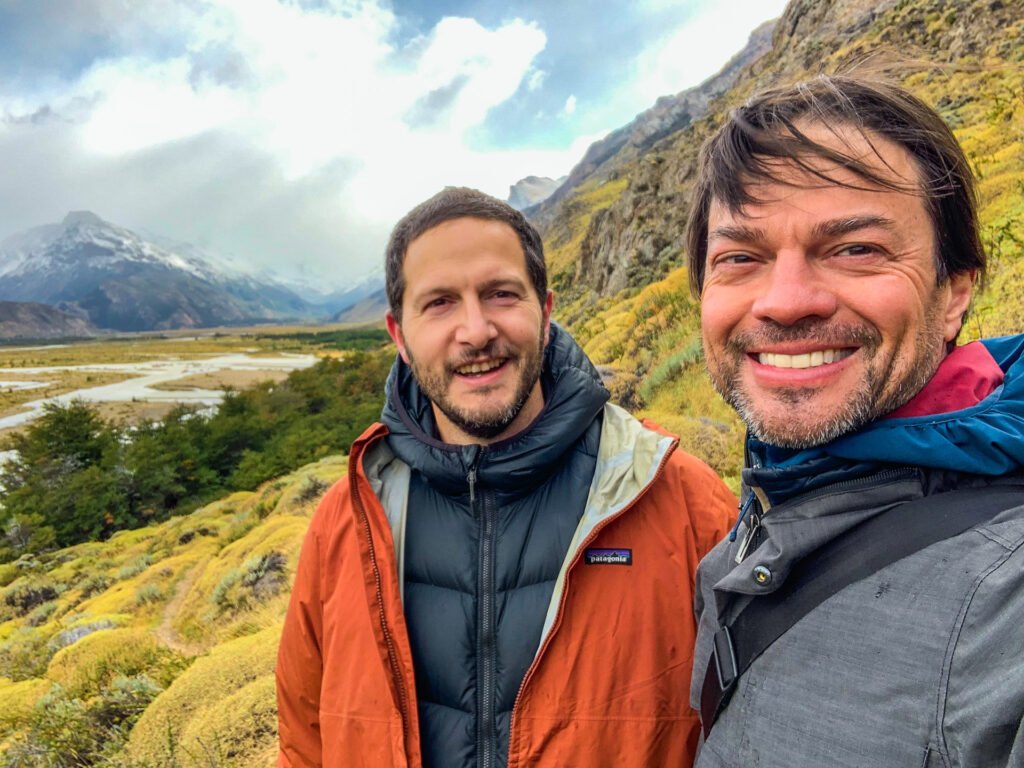
At 42, Nico describes himself as grateful. The future as Nico sees it? It can only get better.
“I am married to Marisol, the woman of my life: unconditional, persevering and intelligent. With her we formed a family and had our only daughter: Sira, the ultimate meaning of everything.”
Rather read than listen?
Find the transcript below
Nicholas Di Costanzo, we’re here in your cúpula on the property of Chaltén Camp in El Chaltén, Argentina in deep Patagonia. I’m just remembering back to where we met. We met in Iguazú, right? In 2018, I think.
Nico: Yes.
We didn’t meet at Puerto before that?
Nico: No, unfortunately not. It was just in Iguazú that you came with family and, well, you were trying to run from one place to the other to see the waterfalls, and you got to the property with all your adorable four daughters behaving perfectly. It was a very nice first impression.
And I remember you stuck a catatonic tarantula on my head. Thank you! We’re in a rainstorm right now, in a windstorm. It’s March in Patagonia. The winter weather has arrived a little early, but yesterday we were hiking Laguna de los Tres and the Torre Valley. Sorry about the background noise, but it’s nature! We’re in the middle of a private estancia on the opposite side of the river from the town of El Chaltén.
Tell me about this place.
Nico: Oh, the place is called Chaltén Camp, and we started this project trying to find a place that met the requirements of being different from something close to town. So we found this piece of land that is bordering the national park. It’s just 3 kilometers away from town, and it also has something really good: a hill between town and our location. That allows us not even to see the lights of town. So we have the best thing about being in the middle of the forest while being close to—not the city, but this town.
Yeah, the town has its charm. It’s a kind of a hippie town that grew out of a border protection program that Argentina put in place in the 1980s. It’s sort of ramshackle—there’s dogs here and there, and no building looks like another building. That’s part of the charm of the place, and we love that about it. But it’s good to be away from the town and feel like you’re in the nature of Patagonia. We’re in the middle of a lenga forest here with some ñires, looking across the river directly at the Fitz Roy Massif.
Nico: Yeah, exactly. Something is that I worked in the industry for a lot of years, and I saw how it started evolving. Suddenly we wanted to claim luxury—we wanted to have special things. At the beginning, they were attached to wood, to things that were more sophisticated or more luxurious. But I kept seeing the process of how simple things used to also be common luxury. I worked in lovely places, and all of them were related to nature—they were surrounded by nature. I remember a guy when I was working as a guide in Bahía Bustamante, and he mentioned that for him, the past was the future. He didn’t like the concept of the cell phone—it was prior to cell phones—and I think he was really happy with his notebook, but a real paper notebook with a pencil! That marked me when he started saying that the past is the future. I think that was like a spark.
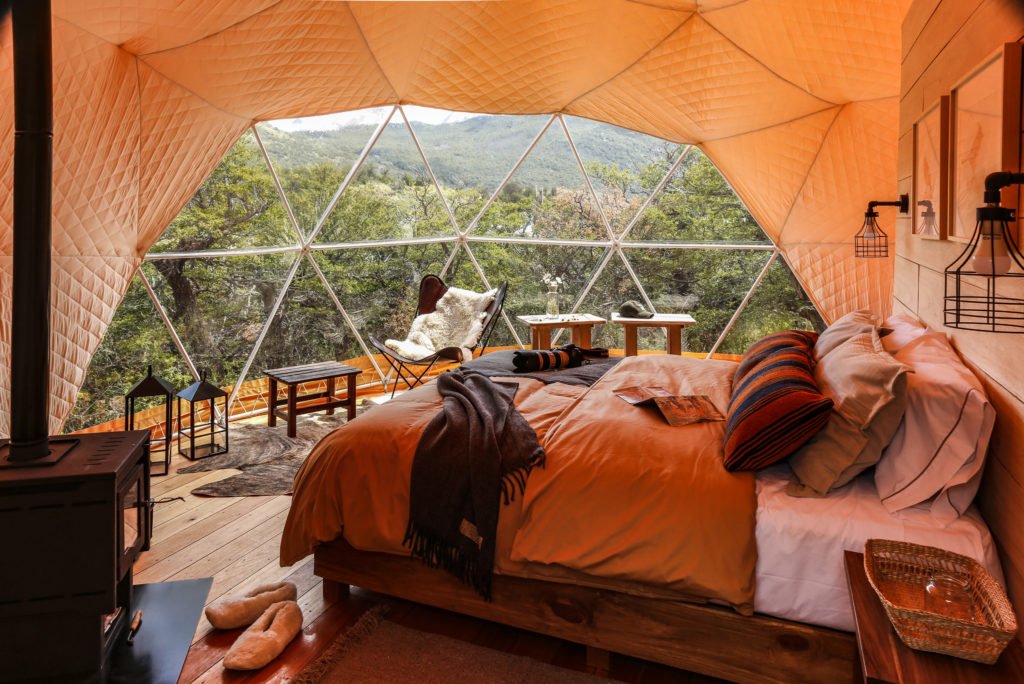
When I started planning what our company—called Glamping Soul—should be, it had to be related to this: trying to evoke simple things, trying to remember that in the end we are animals, part of a chain, and every time we get in touch with that, it’s great. So that’s why when we started our first property for Glamping Soul, which is Chaltén Camp, we went after the pioneer dream. All the area that we are talking about, crossing the river from Chaltén to where we are now, used to be part of the estancia of Andreas Madsen. He was the pioneer who settled here, had his family, spent his life, and was always—I don’t know if the word is “fighting” nature, but coexisting with nature, real intense, cruel, and true nature. He had to fight with pumas, cross the river with his horses to come to this place, and defend his sheep against pumas. He was such a character! We tried to come back to that—to make a cozy place where you don’t feel like it’s something bought in a big shop, but that you enter the house of someone. So that was the nerve for Chaltén Camp. And for Glamping Soul, what we try to do is always have properties where the rooms are not in a single big building. You have rooms coexisting with the environment and a main dome house.
So we’ll give you a second to refill your mate here. We’re passing around a mate. When did Chaltén Camp open, and is this your land, or are you leasing it? Tell me about that.
Nico: Well, it’s a question that keeps coming up because the simple answer is that we have a lease on the land. We are not the owners of this location. The owner is a nice guy from Río Gallegos in the area. A friend of a friend told me that he had a piece of land that would be ideal to develop this project. Because of our location, being 100% off-grid and sustainable fits for this type of project, not for a big hotel. Word of mouth brought us together, he was very accommodating to make things happen, and thanks to that we were able to start.
When did you start the hotel?
Nico: We started with contracts and preparation in September 2019, and then we started the work in November. That was when we started with the first stage. But we were halted because the pandemic started. So what was supposed to be a master plan executed within one year had to go little by little, trying to adapt and deal with all the uncertainty about the pandemic.
So you were on pause for a couple of years during the pandemic.
Nico: Yes. We started little by little with four domes for guests, two domes for staff, one kitchen, and a main dome.
Let me go back to the name of your company, Glamping Soul. You’re developing properties that have soul, right? They’re not big, they’re not corporate. They’re in nature, and they give people a chance to disconnect and connect. Yes, there is Wi-Fi, but that’s in the main dome. In your own dome, you’re in nature. And there is luxury—the luxury of place primarily, right? The luxury of experience. But there are also tangible luxuries: flush toilets, hot and cold water on demand, a wood-fired stove, a warm bed with hot water bottles to keep your toes cozy when you get into bed, turn-down service, cookies, coffee, and tea. All that stuff goes a long way for comfort. But I think you appreciate it more when you’re in the middle of nature because you recognize the effort that has gone into bringing it there in isolation.
Nico: I think everyone defines their comfort zone, but when you grow—professionally talking—every time you’re proud of something you achieve, it’s because you had to go through situations that took you out of your comfort zone. It’s the same here. You go to the gym every day in the city, get home, take a quick shower before work, and barely pay attention to what you’re doing. But here, if you go out and do an 8-hour trek or a 4-hour trek, or just get soaked because it’s raining, and then you return and have a shower—come on, that’s a real shower!
That’s a luxury.
Nico: That’s a luxury! But you also stepped outside your comfort zone because it’s not what you do every day. So there’s a payback. You go out and you get that payback coming back here. We try to keep that in mind and build moments and experiences related to that.
Part of the luxury here too is knowing that this is a sustainable project: your power is generated by solar, and your water is treated in a way that it can be returned to the environment. What other measures are you taking for sustainability?
Nico: For us, it’s really important to be real. We hate greenwashing. We love to see how we’re one more part of the ecosystem. There are a lot of people doing great things, and envy leads nowhere—it’s not about being better than others. But we strongly believe that greenwashing or trying to talk about “eco” far beyond reality isn’t good. That’s happening with the planet as well—we get better solutions the minute we get struggled and face real problems. For a property or project, being off-grid and as green as possible demands a lot of effort if the environment pushes you. We don’t have any alternative but to be sustainable!
You have eight domes now, and your plan is to bring another—is it another four?
Nico: Yes, another four.
The main dome has a living room, dining room, and the kitchen area. I should say that the food is one of the highlights here. Your chef, Omar, is doing a lot in a space that most chefs couldn’t operate in—breakfast, lunch, dinner.
Nico: Lunches are usually box lunches. We don’t like to say no, but it depends a lot on the weather. For example, today that it’s raining, we will probably have people staying in. Instead of just taking a box lunch out, we can offer a meal service inside. But the idea is for guests to go out because Chaltén Camp fits what you do in the destination—you go out trekking. So we prepare box lunches, but if you stay, we try to accommodate you. On a really sunny day, the main dome gets quite warm, so everything is thought to be enjoyed outside.
The last time I was here, it was two weeks later in the season than this, and it was bright, sunny, clear days every day. We were warm, nearly too warm! So you never know with Patagonia, though the one constant is the wind. Although in the wintertime the wind is less, and you may even have more bright sunny days. It’s a beautiful place to visit in winter—June, July, August—though few people are here then.
With four more domes, does that help you expand your service? Does that mean you can add additional amenities? Why add four more?
Nico: It’s going to be healthier for the camp and allow us to give good service with everything running smoothly. At the moment, we have 16 staff members in the operation, accommodating 18 guests. Adding another four domes keeps the same intimate spirit of the place. Originally we thought it would be 16 domes, but we kept it to 12. That will help the place run smoothly.
On property, if you didn’t feel up to a big hike like Laguna de los Tres or going to the big waterfall, you can do hikes right on or near the property, including to another waterfall.
Nico: Yeah. The main highlights in Chaltén are Laguna de los Tres and Laguna Torre. Whether you stay at Chaltén Camp or in town, to go to Laguna de los Tres it’s recommended to take transportation to Río Eléctrico and start from there. From town or from here, it’s the same distance to Eléctrico. We’re also just 3 kilometers from town—a 25 to 30 minute walk—or our staff can coordinate transportation.
On property, one of the highlights on a clear day is that you can spot Fitz Roy right from your bed in your dome! You wake up at night and see the stars and Fitz Roy—unless you’re John Montgomery and you bring rain for three days! But you can do that. We have hammocks right on the shore of the river, small tables with chairs, and a picnic table. On arrival or departure days, you can relax outside your dome next to the river, enjoy a box lunch, or have us organize a picnic for you.
If you want to move, at the entrance of the property there’s a trail that can be done on demand—15 minutes or 3 hours—walking along the huge cliff wall and the river up to an old post called La Florida, and then coming back. That’s a great plan for a day.
We’ve talked a lot about hiking, but El Chaltén is more than that. It’s a climbing destination—you can do rock climbing here. There’s the river for kayaking, pack rafting, and fishing at Lago del Desierto or other spots. Yesterday on the hike, we saw condors right at the Margarita Waterfall. You could spend time with a biologist learning about condors and observing their habitat from a distance, or talk with climbers who have summited Fitz Roy. There are cooking and cultural classes available, or you can meet people running an estancia and learn about their life.
You’re three to three-and-a-half hours north of El Calafate, which is the more famous destination in the area because it’s more accessible. Before we traveled here together, you took us to a really special place across Brazo Rico on Lago Argentino from the national park. From this peninsula, you have a great view of the Perito Moreno Glacier, probably the most famous glacier in South America. What are your plans for that property?
Nico: Calafate grew because it had better access when they opened the airport. We always try to find unique places, and this site is special because it borders the national park and has a great view of Perito Moreno Glacier. It’s inside the estancia of a pioneer named Jorge, who has spent his life fighting the elements on his estancia called Cerro Moreno. It’s authentic—you never know what’s happening when you visit! When we were there together, we got stuck because of the rain and ended up having a picnic next to the tack room where they keep all the saddles for the horses. Some days they’re working with Hereford cattle, other days doing maintenance. Jorge is turning 81 or 82, and he and his family are wonderful.
The peninsula itself allows you to get the best of both worlds. In a crowded destination where you can see the road far away with all the tour buses, our plan is to take people to the glacier walkways by boat right when everyone else is returning to town—after peak visitation hours.
After peak visitation!
Nico: Exactly, at the end of the day! We’ll also offer hikes around beautiful spots on the estancia and the experience of staying in a dome.
You can also ride horses at your neighbor’s estancia, go fishing, and visit Perito Moreno without the crowds during the most beautiful light of the day. You’re only about an hour or so from the national park entrance.
Nico: From the walkways of Perito Moreno, it’s about 1 hour and 20 minutes by land, or an hour and a half if you travel by boat across the water, enjoying the navigation in front of the glacier walls rather than just driving straight to the catwalks.
So you’re planning your second camp on this private peninsula overlooking the lake and glacier. How many domes do you plan to build there, and when do you expect to open?
Nico: We plan to replicate the exact model of Chaltén Camp with 12 domes, but doing it all in one phase. At Chaltén Camp, we’re building the final four domes this April. For the new property, we’ll build 12 guest rooms and two main domes, starting construction hopefully in July or August, to operate for the 2024–2025 season.
You have a history with El Chaltén and El Calafate. El Chaltén is where you’re making your home, and it has a magnetism that calls people back. You opened a hotel here 10 or 15 years ago, and now you’re back. What is the draw of El Chaltén for you? What’s the magic?
Nico: My father passed away when I was eight years old. He left a few things, but one book I got was Cazando Pumas en la Patagonia, the memoirs of Andreas Madsen. Ironically, we are just 200 meters away from where Madsen settled! I grew up reading that book, knowing about his adventures. Later, I studied business administration and lived a conventional life. Then my sister mentioned they were looking for someone in administration at Los Notros, in front of Perito Moreno Glacier—right across from where we’re planning our next camp! Nothing is innocent; everything is connected.
When my sister made that call, I was 23 or 24 years old, and I moved to Calafate to work at Los Notros. The first three months were really hard. I sat down with myself and said, “Nicholas, if you’re not enjoying this, it’s your decision, but give it at least three months before deciding.” After that hard first month, I started enjoying it, meeting people, and getting into the dynamic. Later, I was part of the team that came from Calafate to El Chaltén to open Los Cerros. We arrived in Chaltén during a sandstorm on an unpaved gravel road—the drivers had to replace the windshields because of the sand!
Again, you step out of your comfort zone. Part of the payback is realizing you’re in a virgin place. The mountains are massive, giving you a sense of scale. It connects to the time when pioneers settled here through hard work. Today it’s much easier, but you still feel that nature demands something of you. The mountains, river, and animals give off a strong energy.
It’s one of those places that invades my thoughts while driving or running. I might mentally be here more than where I am physically! El Chaltén is at a moment of potential growth. There are about 2,000 to 3,000 residents in peak season, dropping to about 1,000 in the winter (June, July, August). The town faces a decision: do we expand town boundaries to provide affordable housing and accommodate tourism workers, or keep the town boundaries fixed? What are your thoughts on managing growth?
Nico: When towns grow, like Calafate when the airport opened, unmanaged growth causes infrastructure challenges with water and services. In Chaltén, people want to keep the spirit of a small village, which is great, but you can’t block the sun with your finger—growth needs to be planned. Years ago, visitors were prepared to sleep in base camps in rustic conditions. Now, visitors expect more infrastructure and town accommodations. To support them, you need housing for workers. At Chaltén Camp, we house all 16 staff members on property because workers can’t find affordable rentals in town. A thoughtful solution would be creating a planned residential area nearby for year-round residents and workers.
How many nights do most people stay? I think of this as a 3 to 4 night destination—minimum 2, but ideally 3 or 4. How many nights do you recommend?
Nico: Minimum is two nights. Years ago, people did full-day trips from Calafate, which was crazy because you spend hours traveling. Now, average stays in Chaltén are longer than in Calafate because in Chaltén you need time to get clear weather windows for the mountains. We suggest three nights as ideal for a first trip to Argentina, or four nights if focusing specifically on Patagonia.
You have some great restaurants in town now. What are some of your favorite spots in El Chaltén?
Nico: My personal favorite is La Cervecería, founded by a wonderful woman who was permit #2 in El Chaltén (who sadly passed away last summer). It’s cozy, authentic, and has its own microbrewery. Another fun place is La Tapera, run by Chipo, a huge Boca Juniors football fan—the decor reflects his passion! For meat lovers, Los Hachadores offers great traditional asado (and vegetarian options). For dessert, Domo Blanco is one of the best ice cream shops in Argentina!
What’s your dream, Nico?
Nico: My dream is happening right now! We expand our comfort zone and keep dreaming. Together with my business partner and lifelong friend Mariano, we want to create meaningful projects while balancing family life. My daughter Sira recently asked me, “Okay Dad, but isn’t one camp enough?” It reminds me to stay present and appreciate what we’ve built. I started coming to Patagonia at age 12 to fish and be in nature. Creating Glamping Soul and Chaltén Camp is a lifetime dream come true.
Nico, how should a proper Patagonian make a mate? Take us through the steps.
Nico: You fill your mate gourd about 65% full with yerba (like La Merced). You cover the top with your palm, turn it upside down, and shake it for 10 seconds to bring the fine dust to the top so it doesn’t clog the bombilla. Then you tilt the herb to one side, insert the bombilla, and add a first splash of warm water to hydrate the leaves. Once it’s hydrated, you pour hot water (not boiling) until the yerba floats, and drink until it slurps! Then refill and pass it to the person next to you as a shared experience.
Cora, any rules we missed?
Cora: You can’t move or stir the bombilla—it’s not a spoon! The bombilla must stay fixed at the bottom.
Nico, it’s great to be with you again. I love what you said about “the past is the future.” Thank you so much.
Nico: It’s a pleasure, John. Happiness is not real unless it’s shared!