Podcast: Play in new window | Download
Subscribe: Apple Podcasts | Spotify | TuneIn
LANDED Podcast 037
Juan Pablo Culasso – Nature Recordist
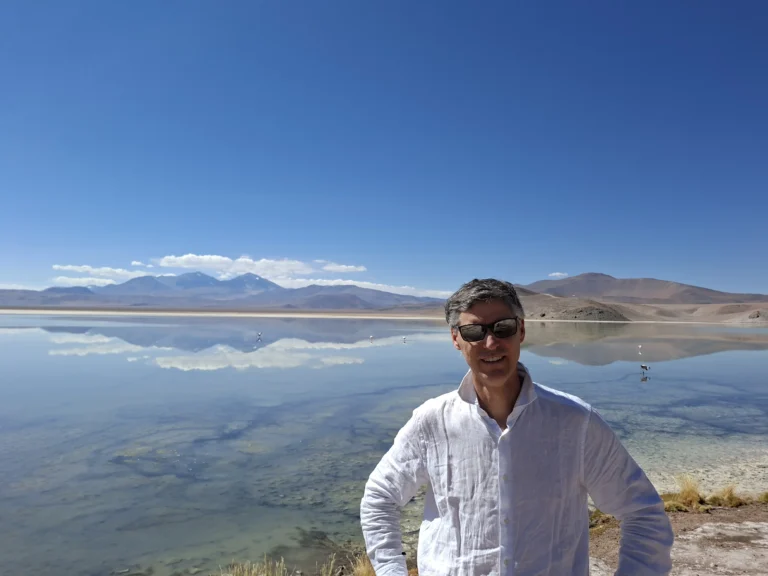
Juan Pablo Culasso is a master interpreter of the natural world. Through his field recordings, he takes listeners deep into wild spaces: the Atlantic Rainforest of Argentina, the cloud forests of Colombia, the Brazilian Pantanal, and coastal lagoons of his native Uruguay. Entering these soundscapes is immersive, transportive, and invigorating.
Juan Pablo trained under Jaques Vielliard, curator of the Neotropical Bird Sound Archive at the University of Campinas (UNICAMP) in Brazil. Later, he studied nature sound recording at Cornell University’s Ornithology Lab. He’s become one of the largest contributors to the Macaulay Library—the premier scientific archive of natural history media. With more than 20 years of experience, Juan Pablo’s expertise as a sonic curator of avian environments is unparalleled.
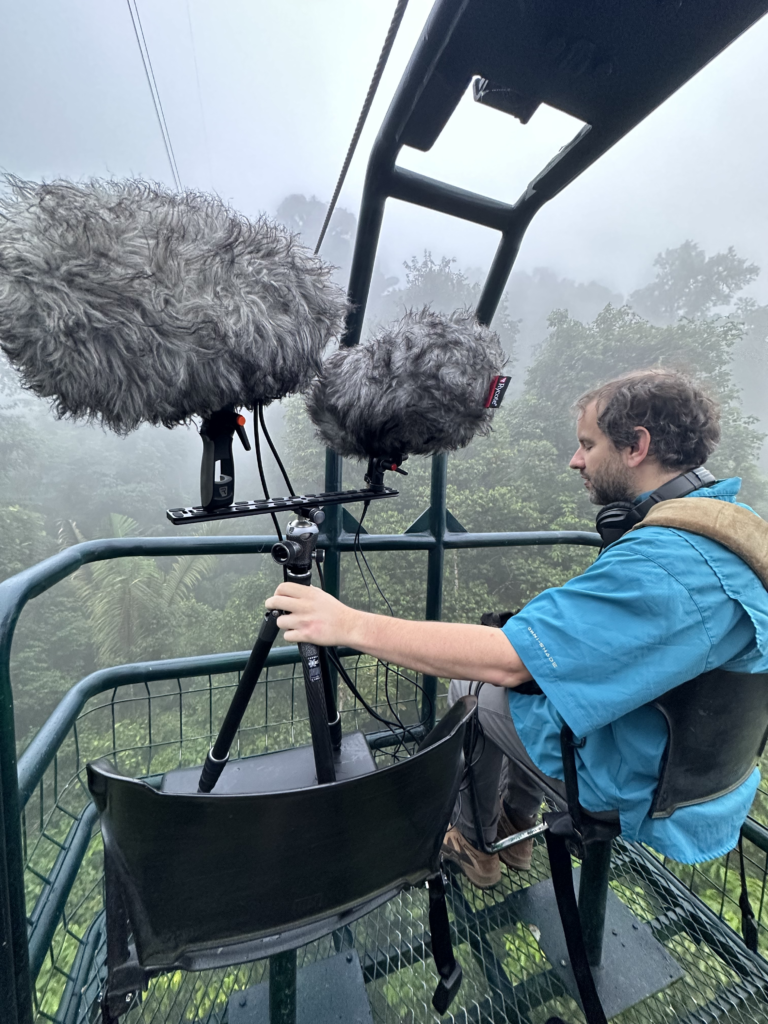
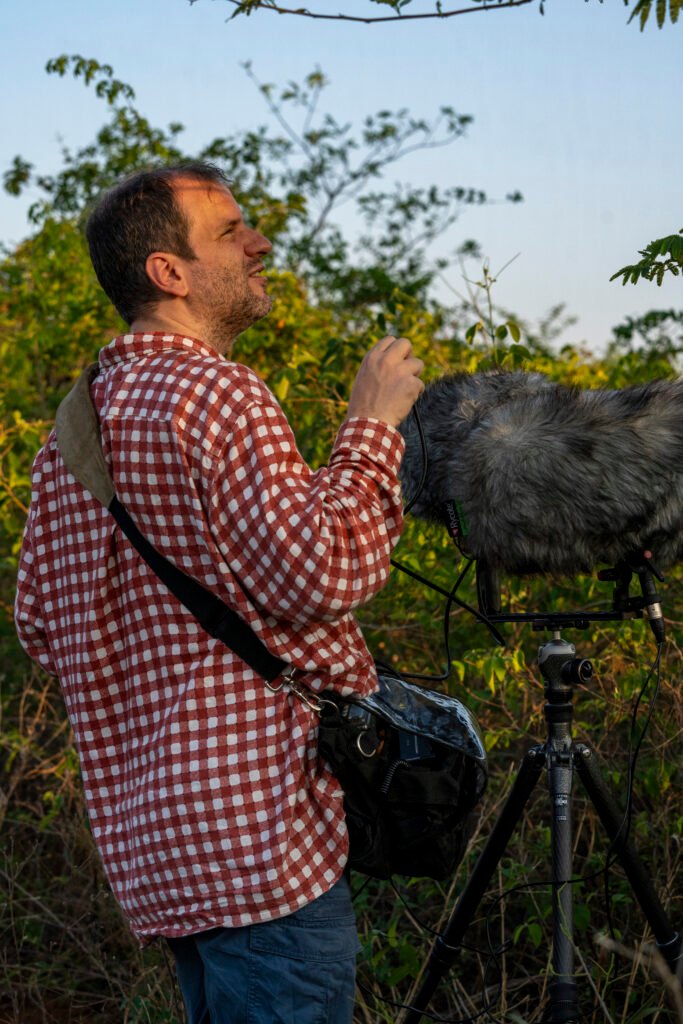
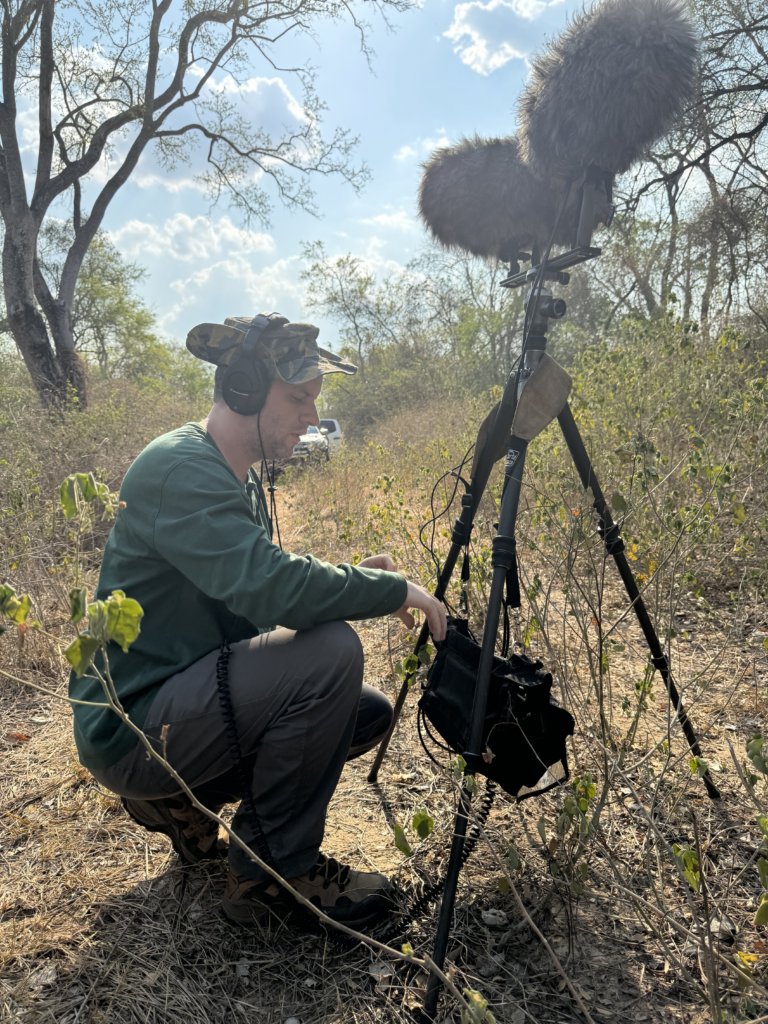
Juan Pablo has an acutely musical ear and an astonishing memory. Barred from pursuing a traditional biology degree due to barriers in Latin American education, he trained himself to distinguish countless bird species by ear. This talent helped him win National Geographic’s “Superbrains” competition in 2014.
In 2024, he was named to The Explorers Club 50, honored as a “Bioacoustic Engineer & Accessibility Advocate” for reframing exploration as a multisensory practice (one built on listening rather than looking) and for his work making the natural world more accessible to people with visual impairments.
He writes, “In a world where nature is often forgotten or harmed, these recordings remind us of what we could lose. They’re not just sounds; they’re the voices of places that need our protection. I’ve been recording the sounds of different habitats, from the rainforest to the Antarctic. Sadly, some of the pristine soundscapes I recorded do not exist anymore.”
Juan Pablo lives in Bogotá with his wife, Sara (an avid birder) and his dog Alegra.
You can find his work on Spotify
Rather read than listen?
Find the transcript below
Well, Juan Pablo, let’s introduce you to our listeners. You’re from Uruguay, but you live in Colombia. You started recording and became interested in the sounds of nature at a young age. You’re from Hawaii, but you live in Colombia. You started recording and became interested in the sounds of nature at a young age.
Yeah. When I was 16 years old, I had the chance to go on a field expedition with a biologist in my country, Uruguay. And one of them gave me a recorder, a microphone, and basically he said, “Here’s the record button, the play button, the stop button. Try to record something.” And the very first sound that I captured with the microphone was a Kingfisher, and that Kingfisher really changed my mind in a really amazing way.
It was a really warm day in Uruguay in January 2003, in the west of the country near the Uruai River. We were searching for migratory birds, seed eaters. They are extremely endangered because the grasslands that they use to feed on are disappearing, and we tried to really find those tiny birds. A beautiful expedition, four or five days searching, listening, was my very first time with professionals of nature in the field. And when I got that recorder, a cassette recorder on my shoulder, got my microphone in my hand, and pressed the record button, I was beginning to listen to that sound through headphones. It was really so nice because in that time, John, from my perspective, understanding the world through sounds was my way to really understand what’s around me. But listening through headphones with a microphone and focusing on a bird was so nice. And I asked biologist Santiago, “What do I need to do to become a biologist or become a nature passion or a thing like that?” And he said, “You need to study biology.” Well, my life pushed me in other ways, but in the end, I really got that trophy and dedicated my life to recording nature and conserving our sound heritage.
You’ve trained now in Brazil and also done work with the Cornell Ornithology Lab.
Yes, yes. To your audience, basically, on the surface, there is a lot of discrimination against blind people in education. So I need to learn most of the things by myself. Of course, I had the chance to know amazing people along the way in Brazil, of course in Campinas at UNICAMP with Jack Villar [Jacques Vielliard], and then amazing people in the Cornell Lab of Ornithology. I got a lot of knowledge from them. Finally, I give that knowledge to other people like me who cannot study using the mainstream, using the main way. So that’s the thing. Nature gave me a lot of things, gave me a lot of knowledge, gave me the chance to know our world, and now I’m trying to do the same thing to my community.
You’ve become a major contributor to the Macaulay library. Which is probably the most important library of nature sounds.
Yes, yes. I contribute to Macaulay because in the neotropics, even in my country, Uruguay, there are not too many recordings or register of sounds. Macaulay, even today, 70% of the sounds are from North America, and I think that here in South America we have one of the most amazing treasures that is: 66% of the bird species are here.
So it’s really nice because here we have a lot of sounds, a lot of forest, a lot of things to record. And as you know, John, in every 100 photographers, only one sound recordist. So we are a bit of a rare species in the world that really puts the sound in the center of the story. To be sorry for the filmmakers, but filmmakers put the footage, the image, in the center of the story: 4K, 8K, but the sound is always in a secondary way. Nature recordists like me, even with my—again, I don’t like to talk too much about that—but my disability allows me to really understand basically what’s around me, understand the perspective of the forest, to understand what the forest is saying to us, is telling a message, is saying something. So with my microphones, I try to go there and capture and record that kind of music. I think, put that music or those sounds in a different series of actions to really put those nature sounds together for the people, you know. Most documentaries or things like that are really focused on images. Today, attention to sounds is growing really, really slowly, but this conversation regarding sound recordists, the importance, the priority of that- I’m talking to that, I don’t know, maybe 15 years ago or 20 years ago. So I’m so happy that this conversation is really going to the table, but it’s really, really going so slowly, and we are losing that ecosystem; we are losing, to a really high degree, that kind of music today because of habitat change or things like that, human noises. I say to you, it’s like an invisible loss. You are not really aware of how much we are losing our soundscape. And this is so sad. This is really, really sad. And with my publications on several things, I think that I’m giving the world a bit of that magic because, in my opinion, sound tells you a story, a beautiful story.
My wife and I have been to the Amazon since we last talked. While we were on the canoe, right, away from the motors, away from engine sounds, I took time to close my eyes and to turn on my Zoom recorder and to see what I could see with my ears. I think there are some things about being in a jungle environment that cause you to be able to observe more without your eyes. The green, the leaves, it’s everywhere. And you can’t really penetrate it with your eyes.
It’s basically your brain opening new ways when you visualize things. It’s this thing. But when you start to listen and pay attention and be open to that forest, it’s not common for your brain really to try to interpret what’s happening around you outside. So you are opening a new way in your brain, and I really, I’m 90% sure that that recording that you did with your recorder will be more remarkable than many photographs that you took, because sound really connects you directly with your brain. Images need some interpretation, but sound is, it is what it is. So it’s really, really nice how a soundscape can change the way that you understand where you are. That’s the thing. It’s a great exercise. It’s not easy. You need to learn. It’s a learning curve. Yes. Because you are using your ears. Basically, 90% of people don’t use their ears. Only you use your ears when the energy comes out; you are beginning to listen to a lot of clickings and cracklings and things like that. But in your normal life, you don’t use your ears as much as you can really. So I really believe that soundscapes and nature sounds can allow people to be more sensitive, right? To be more aware of themselves. When you are aware of yourself, you are aware of what’s around you. This is my experience that I can share with you regarding this.
If you want to practice using your ears, go into the forest at night. It’s really nice. The very first time, it’s a little alarming. “What? Why is there so much noise?”
But when you are with someone who can help you to interpret, to understand, you realize there’s more. The other sound I will always remember from this last trip to Peru. We were in Colca, and at one point more than a dozen condors were flying right above us at such a close range that, Pablo, we could hear the sound of the wind in their feathers. I’ve been around, you know, been able to see condors in many places, but I had never heard that. You inspired me.
Let me put this thing in a really more common situation for many people, maybe in the north. I had the chance to listen to a really calm lake in Minnesota, the sound of the tail punching the water, the tail of the beaver. And that sound in the really silent place was really, really, really amazing. So yeah, soundscapes are remarkable because tells you some stories. We did some experiences in some countries in theaters, turning off the lights and putting on 10 minutes of a soundscape, and the memories of the people were really interesting. In 2011, John. Imagine, 2011.
And you had something like 10 minutes with the lights off. In a theater, a crowd of people, and you played soundscapes for them. What did people say to you after?
Well, a lot of memories. Most of them nostalgic memories of the grandfather, grandmother, a little farm that my grandfather really… Yeah. The people were extremely emotional because that woke up emotions. So the energy in that place was so beautiful. A bit heavy, but beautiful at the same time.
Well, you’ve taught me also to use the Merlin app more frequently. I live in the mountains of northern Utah, and I’ll go outside to a quiet area in the woods and turn on the app, and I’ll think I can hear maybe two birds, you know, maybe a Kingfisher or maybe a Magpie, a Robin, but the app can identify maybe six or seven more birds than I’m even realizing I’m hearing. And as you’re using the app, when the bird sings, that name lights up on the screen, so you realize who’s singing, and then it shows you a photo of the bird, so it helps you to recognize it later. It’s an amazing tool, and you’ve contributed to this. Macaulay is part of the Merlin app.
Yes, my sounds are part of Merlin. Yes. And to put the story in the present for the audience to understand, many years ago we really used some CDs or cassettes to memorize the sounds and go outside and try to listen, record things, identify by ourselves. If I didn’t know the sound, we had, for the millennials maybe, Yahoo groups or things like that to share our sounds on platforms. And now today, one of the most common situations that I’ve lived when I do workshops regarding identifying birds by ear, most people say, “No, I don’t have enough of an ear to recognize.” You know, always when you try to teach people a new thing to the people, most of them say, “I’m not sure that I have the ability to do that.” You know, it’s a comfortable answer. But today, with that application, with Merlin, I think that is an amazing tool. Five years ago, six years ago, if you said, “I would like an application to turn on the microphone in my smartphone and identify birds,” most of the answer would really be that that is impossible. So the technology is an amazing tool, is growing so fast. AI models, machine learning things are really allowing people who don’t know nothing about sounds or birds to really enter to this world and really do this more enjoyable for them, and then really the frustration of some people really lower to zero, you know, because for that applications, you need to get some books, really thick books, a lot of pages, a lot of things, and really hard to navigate to in that field guides. But today, it’s really easy to enter this world again. Sorry to be repetitive, but this activity—go to nature, understand what’s around you today—is easier than 5 years ago.
There are still major gaps, though, in South America like you said. In North America, the western US, I can find 100% of the birds, and in South America, we were near 20% of the birds. But you’re making an extra-large challenge for Merlin because Colombia has the highest number of bird species in the world.
And you act as a birding guide. You’re also a sound recordist, a sound designer, in a way, a composer. And you have, I think it’s more than 16 albums on Spotify.
Yeah, 16 albums. Two more albums are coming, highlighting a couple of ecosystems. I’m so happy for that because it’s a dream come true, and yes, I try to highlight extremely endangered ecosystems like in the Chaco in Paraguay—it’s like a really devastating desert; the logging is really hard, it’s horrible—and other ecosystems that really are suffering the same thing. And regarding birding guides, yes, but I don’t like to do this too much because my experience of guiding people listening to birds is a different experience. I don’t like, in Spanish, we say to them “list” or checking lists, you know. These people watch the bird for 5 seconds, that’s it.
Really boring people. I’m so sorry if someone is one of them, and sorry, you are so boring. And I prefer to guide people that wants to know why the bird is singing and when, why the bird is there, you know, to understand the natural story of that place.
If you’ve never observed birds closely, you have so much to look forward to in your life if you start paying attention to them. I just read a book about the history of birds, and that book argues strongly that birds are dinosaurs or dinosaur descendants. And even watching my chickens, Juan Pablo, listening to the sounds they make, watching the way they interact, I’m crazy about birds. And for me, it’s such a memory trigger, too.
Like when I hear a meadowlark or the sandhill cranes that live here, or when I’m in the tropics, oropendolas responding. Like when I hear a Meadowlark or the Sandhill cranes that live here, or when I’m in the tropics, or a pendulas respending, kettles [oropendolas’ responding calls], I’m transported to other moments and memories and people I was with and how I felt, and you know, maybe with my children when they were young. It’s almost the same response that you get from certain smells or perfumes or the smell of cooking, you know, absolutely take you back.
Absolutely, John. My trips with my wife are extremely… when we plan a trip, we try to plan not a visual trip. We try to use our other senses. So, I don’t know, in Spain, we try to go to vineyards to get some wines and cheese and go to different botanical gardens to smell the flowers, go to nice restaurants, enjoy the things. You know, my wife Sara loves arts and things like that, of course, but you know, I get extremely bored when we enter a museum for so many reasons. And I said to her, “Sara, go, and I think for Monet. And I stay in a chair enjoying a cafe and a coffee, and you go and see all the squares and take the photos and take some time in front of every square and things like that.”
You know, we were in Tokyo recently. Not a place where you would think you would find bird life. But in the shrines and also on the city street, there are crows everywhere. So you can find this kind of interaction, this kind of addition to the environment, no matter where you are. That’s a city of 39 million people. I mean, if you can find wildlife to listen to in Tokyo with all the noise and all the chaos, imagine what you can do in your own backyard. And I’ve stopped listening to, oh, let’s call it ambient music while I’m working. You know, it’s repetitive. There’s not really any satisfaction to it. Although it is good for blocking out other sounds that can distract you while you’re trying to write. But what I prefer now is to listen to your sound recordings. They take me somewhere and it’s somehow feeding my need for greater connection with nature. You talked about it as composition or as songs. These really are songs and I’m grateful to you for capturing them.
My idea, John, when I record something is not only to record but recording, you know, it’s like press the right button and, no…
No, it’s not passive. You’re composing. What are some of your favorite bird songs?
My favorite sound, I think, will be published in a couple of months in this new album. One of my diamonds will be there in that album. I prefer not to talk too much, but they are in really extraordinary ecosystems. That choice was even remarkable for me, listening to that soundscape. Really long soundscapes, more than 50 minutes of amazing places in both places. And believe me, you are going to get a time machine and go back 10 million years ago.
These are as rich and as textured as a piano concerto. They’re much more meaningful than some of the ambient or meditation music, spa music that you could be listening to.
That’s the thing, John. I was hired by some reserves because they don’t like ambient music for their spas, for example. They don’t like meditation or things like that because they are really mainstream things. They want… We have some friends in common, John. But that friends is one in a million. And he has the sensitivity to understand the thing. It’s really nice when you have the sound that is around you in a really hard time because most people don’t like to really wake up at 4:30 a.m. to go to the middle of nowhere. It’s understandable. But the magic happens in that time. You know, having this magic at 10:00 a.m. in a beautiful place really increases the experience by a thousand percent. Again, it’s a really new field. Most people don’t understand the idea here of how amazing the sound really performs into the experience of a nature hotel or things like that.
You’ve helped our friends at Mashpi Lodge, at Awasi. You’ve worked with World Wildlife, and I think one of the conservation societies in Paraguay, if I’m not wrong. Juan Pablo, one of the turning points in your early career, I think it was in 2013, you were one of more than 300 applicants for a National Geographic special about people with exceptional abilities. Tell me more about that experience. What did that mean for you?
Until now, I’m telling you amazing things, but of course, in our careers, there are high points and low points. In 2013, I was really almost giving up. And I received the newsletter regarding that show, and I applied with no expectations, of course, never. And well, there were so many people there doing math things or memorizing things. And I was the only crazy person regarding sounds of birds, you know. And yeah, it was a beautiful experience. It was so nice, believing that I was there with no expectations. On the day before the recordings of the show, my guide dog got really sick, and I sent an email to the producer canceling my participation. I said, “I need to cancel because my guide dog is a bit sick and I’m not feeling confident to travel alone.” And they said, “No, Juan Pablo, please think more about that.” Okay, let’s try, and I need to go to the hospital with my dog to understand what’s happening, if the doctor allows me to travel. And in the next morning, I visited the hospital. The doctor did the last exams on her, and yeah, he said, “Yeah, you can travel. Be sure of the medication and things like that.” When I did the first participation, there were two rounds: semi-finals and final. It was extremely amazing, John, because for the very first time my work with nature recording was recognized, you know, because you receive a lot of things: “Ah, Juan Pablo, you’re amazing, amazing, amazing,” but you cannot live or pay your bills with amazings or wonderfuls. Again, I prefer not to talk too much, but most people, when they see a person with a disability, believe that we are extremely sad, depressive, or things like that. Of course, John, we and you and they and them suffer sadness some days, get a bit depressed or things like that. All of us are really… not to be blind or whatever, but when a person watches blind people believes that we are so sad and we cannot do nothing and we are… believe that we are sitting on a chair 24/7 without going outside and things like that. This is the most common thing. It’s an exception to the rule when you really get a person sitting in front of you, and they treat you like a person. When you have the chance to go to a show, and you can perform a different thing, and you really can show the people that you can do things. You can do two things, but well, we live in a society where it’s left or right; nothing is in the middle, you know.
If someone is interested in recording soundscapes, is there some equipment you would recommend?
It’s like in some in all activities. You can do this at an entry-level, medium level, or high level. So you don’t need to spend, I don’t know, $8,000 on a recorder machine and another $6,000 on microphones or things like that, but you can begin to record with your cell phone, and then you can plug in a microphone into your cell phone, and then if you like… you are enjoying the quality, or you want to really improve the quality, you can really jump to a Zoom recorder or a Tascam recorder, and then… and then… and then it’s like photography, you know, never ends. Photography, guitars, there’s no end. And nothing ends, you know.