Podcast: Play in new window | Download
Subscribe: Apple Podcasts | Spotify | TuneIn
LANDED Podcast 033
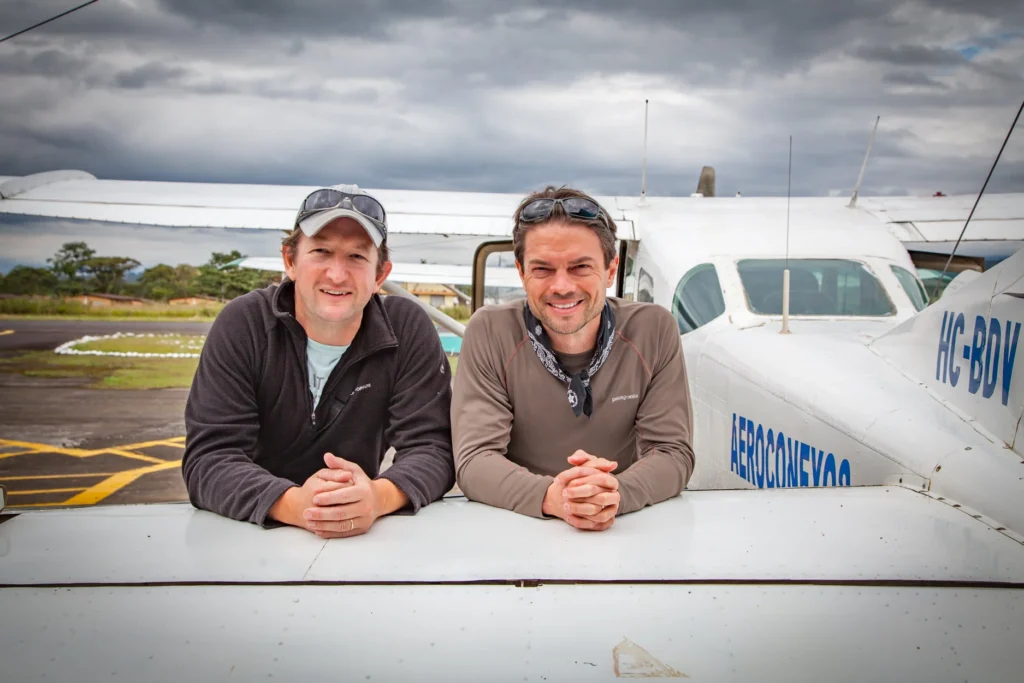
Simon Heyes
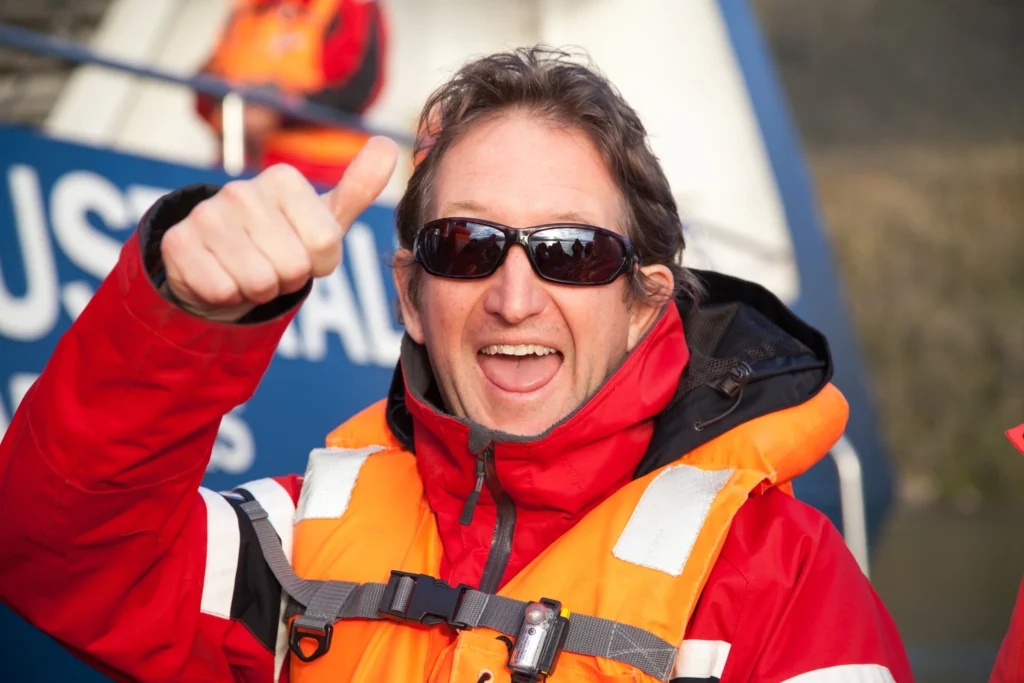
Simon Heyes is an ace of Latin American travel—the final boss, the old gaffer.
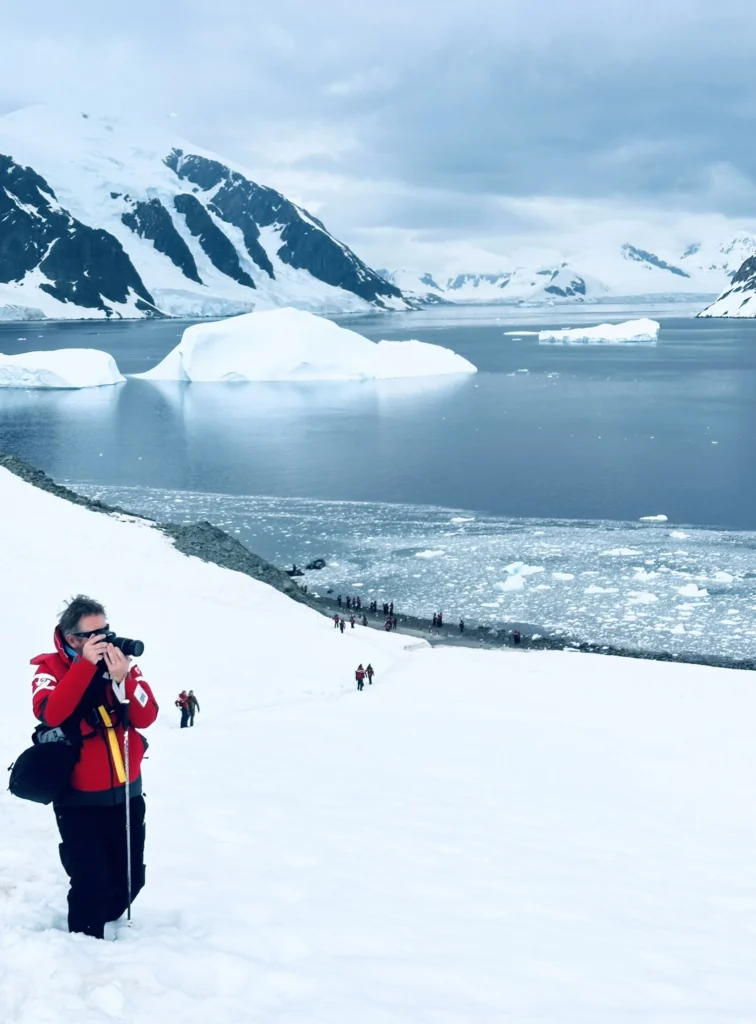
Simon fell head over heels for Latin America back in the early 90’s. He’s been a guide throughout the Andes—from Colombia to Chile. Then, after working for leading specialist UK tour operators, he started Senderos in 2004.
The question Simon asks is: How can you love Latin America and not want to preserve it, conserve it, and help it regenerate?
Simon argues that tourism is uniquely capable of doing just that. It is a powerful tool for Conservation, Community, Culture and sustainable Commerce.
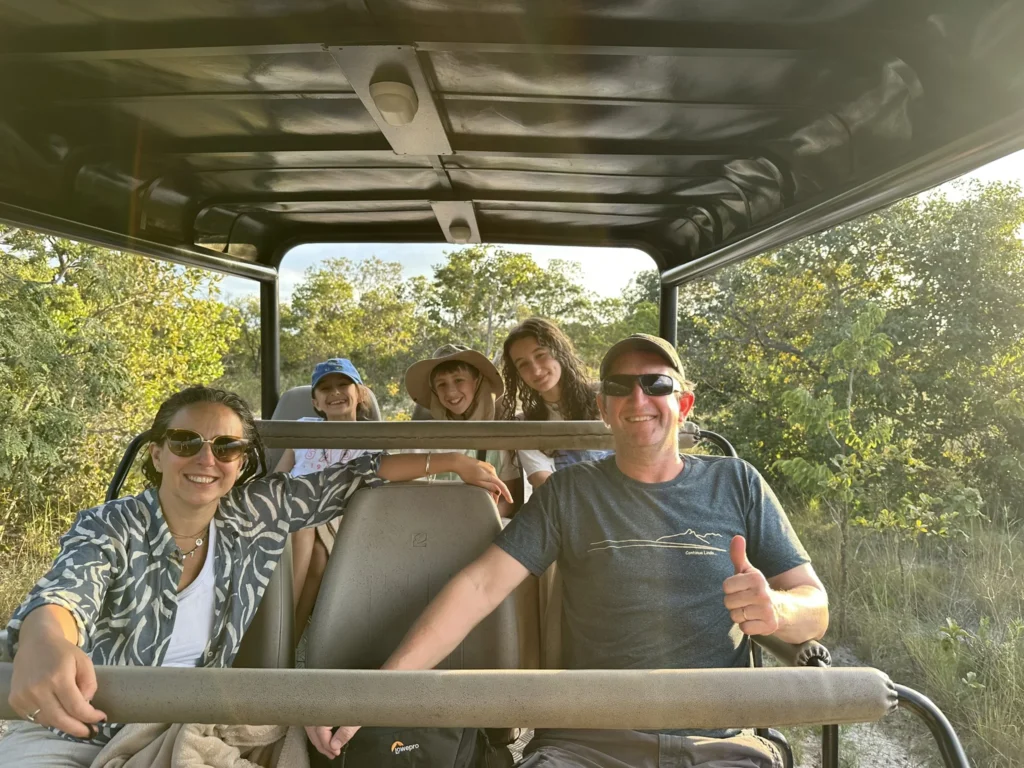
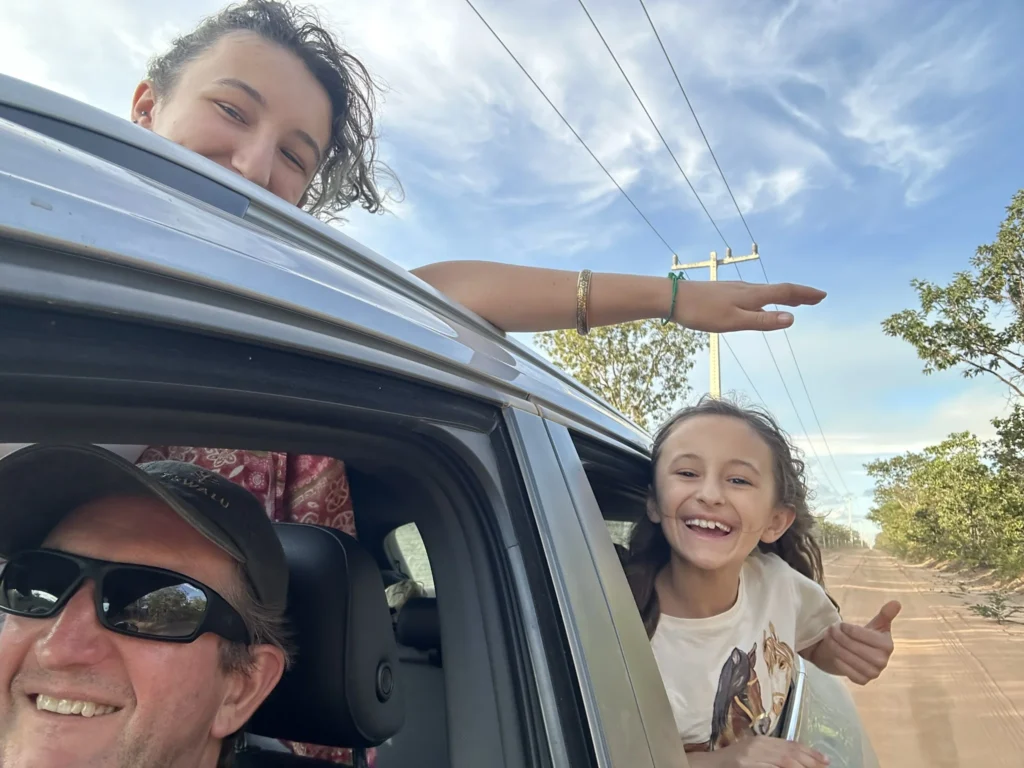
Senderos is a positive-impact focused, UK-based marketing, sales and PR firm. Its clients are conservation-focused wildlife lodges, private estancias, boutique hotels and expedition vessels in Latin America.
Simon has been involved with The Latin American Travel Association since 1996. His firm has been a proud affiliate of The Long Run since 2017, and founding members of The Conscious Travel Foundation. Senderos gained B Corp certification in early 2024—bravo Simon! Well done—joining Travel by B Corp soon after.
I’m chuffed to bring you this conversation with The Ledge himself, Simon Heyes of Senderos.
Rather read than listen?
Find the transcript below
Simon Heyes, it’s great to hear your voice again.
Simon: John Montgomery of Salt Lake City, it’s fantastic to be here with you and hear your voice.
Park City. Now we’ve moved, changed things.
Simon: You have. You’re out in the rural Idaho now, aren’t you?
I have. My only neighbor is a bald eagle.
Simon: Wow. Amazing. I aspire to this. I’m still in Bristol, but I’ve just been in the wilds of Patagonia and every time I come back, I think I love Bristol, but I think, ah, I need a little bit more countryside, bit more nature.
Yeah. You and I were just in the same place. Cerro Guido. Well, isn’t that a lovely thing? Someone mentioned, not knowing that we knew each other, but probably suspecting that we did, that you had been down there as well. What, in October?
Simon: That would be Gonzalo. And yes.
Yeah. I mean, what a place that is.
Simon: It’s shockingly beautiful.
Yeah, it did blow me away. And I knew it was going to be good. I haven’t been down to Torres del Paine for a few years. I did actually visit Cerro Guido 10, 11, 12 years ago when it was in a different, sort of, in a different form. But…
Simon: Yeah, so the landscapes were familiar, but, you know, the hotel was all new.
Did see a huge amount of incredible landscapes and incredible wildlife, but an armadillo wasn’t on the list. So what else did you see when you were there that we can compare notes?
Simon: You know, the most unscripted moment, let’s call it, was when we were riding. We were really riding. And you know, there you can run. You can canter as fast as your horse can carry you and your wits will allow. We’re mounting this valley, and in the distance is that peak of Paine Grande that they sometimes call Bart Simpson because it has spiky hair and a straight-faced profile. Well, in the distance we see a black stallion, and he’s circling something, and he’s very agitated. He’s rearing up on his hindquarters and giving us the full cinematic, you know, front-leg cycle motion.
Incredible.
Simon: And we get closer and we realize he’s protecting another horse, a horse that—and these are wild horses, they’re not part of the ranch—this horse has had some sort of an injury or an illness, and it’s lying down, and it’s on its last breaths, and it’s giving us this wild-eyed stare. But this beautiful black stallion just keeps circling and doesn’t want us to approach. And of course the gauchos want to get closer to find out, take some photos, go back and talk to the vet, see if there’s anything that can be done.
And the stallion gives us some space to do that. And he—I think he senses that we’re not so much of a threat, but he’s pacing along sort of the mesa top nearby. And we do our little check and leave them in peace all the time, wishing we could do something for this horse. And as we’re going away, he does another one of those hind leg rear-ups, you know, straight off the silver screen, and gives us the whinny and then comes back down and starts protecting her again.
There is an extraordinary drama to Patagonia, isn’t there? And a real drama to Cerro Guido. I think everyone who goes there—nobody will have that same moment again. That’s yours. That won’t ever be produced. But there is something where you enter some kind of flow of natural splendor. Cerro Guido is a portal into a dramatic wild nature that very few of us get to see. And I think everyone who stays there has these moments. No one’s going to have the moment you had, but everyone’s going to have something.
I’d just come—it was a very unusual visit because I’d just come from doing a huge amount of walking in El Chaltén, Laguna de los Tres. Spent a lot of time with Alberto del Castillo from Estancia Cristina, with Mariana and Carla and him. And then I arrived at Cerro Guido, and my back decided to go into spasm. So I was in this extraordinary place—107,000 hectares, over a quarter of a million acres of wild Patagonia to explore, and I could barely get to my room. But I did manage to get moving again.
And actually there’s always something you can get from every moment, isn’t there? And the fact that I wasn’t out horse riding with Victor as much as I wanted to be meant that I sat down with Victor in the stables and interviewed him, and I sat down with Claudia, the amazing chef, in his kitchen. And I chatted to a lot of people. And then I did have my moment: the next morning I managed to get my back moving and went out on the conservation safari with Pía and Sebastian and Mariana, and we spent the whole morning around the Condorera, you know, the condor cliffs that you would have visited.
It was very Patagonian: stormy, dark skies, kind of light rain. And we weren’t focusing on the keystone species; we were just focusing on the incredible views and the drama and the wind and just being outside in this amazing place. And as we headed up to the Condorera, we saw some falcons and two falcon chicks which had been in a nest the week before and were now trying to learn how to fly, with the parents keeping an eye on them. Amazing, kind of watching these falcons trying to fly in the gusts of Patagonia. And then we saw a fox, and it was just beautiful. But we were about to head back when Pía said, ‘Simon, you should come and see my living room, my living room,’ she told me. And I was like, because she knew my back was sore and she thought, ‘This old boy needs to go back and have a cup of tea,’ but ‘I’ll show him my living room first.’ And we moved over to the cliffs, the condor cliffs, and there was a condor up there, and we were looking at the condor, and then suddenly she said, ‘Puma.’
And she said it from her—she said it from her midriff, from her stomach—’ Puma.’ And she told me that she follows her gut instinct, and down there, probably only 20 or 25 meters, were these piercing eyes, and it was extraordinary. I’ve never seen a puma before. I’ve been very lucky with wildlife sightings all over Latin America, but…
Panthers.
Yeah. Yeah. Well, just missed the black panther. But it was…
Really a panther, right? It’s a jaguar, too. But the puma—Panthera. Panthera is the Latin, right? So, you’re absolutely spot on.
But yeah, we were—moving away from Patagonia, we were at Trijun in the Cerrado in Brazil in April, and we were there at the same time as a National Geographic journalist whom we’d organized to visit with my wife and my kids. And the journalist, she went out, and she saw a maned wolf and a black jaguar that afternoon. And we didn’t. So, you just never know with wildlife sightings, do you? They’re always different and never to be repeated.
I want to make sure all the Americans listening know that he said maned wolf. A wolf with a mane, not a maimed wolf.
Yes, quite right. Sorry. Yes, quite right, John. Thank you for pointing that out. Yeah, maned wolf, which is an extraordinary creature out on a limb in evolutionary terms. It’s neither a wolf nor a fox; it looks a little bit like both. And Stanley Stewart called the maned wolf the ballerina of the Cerrado, of the savannah, which is Brazil’s greatest, great savannah and most biodiverse savannah on the planet. And the maned wolf is the closest—it’s a wild dog, but it’s an extraordinary creature and a keystone species and emblematic of biome health. And as we know, all interconnected with all of the other creatures in the biome. So yeah, very important.
Same vibe as a wild dog in Africa but longer legs.
Yeah, exactly. Very, and sort of delicate-looking. I mean, there’s a sort of—you feel a connection with them, and they feel fragile as well, and you sort of feel protective about them.
How did you get started in all this? I know you were a guide in Venezuela and you were a guide in Peru, but where did that come from?
So, I think calling me a guide in Venezuela is probably overstating it. And I was—I did work as a guide for a short time in Venezuela in ’94. And let’s just say I probably didn’t cover myself in glory as a guide. I was a bilingual trekking guide in the Andes and didn’t have a great grasp of Spanish and didn’t know the mountains that well. So, it was a fairly inauspicious start to working in tourism, but I learned fast, and I fell head over heels in love with Venezuela, and then Chile, and then Peru, and then Ecuador on that first sort of 18 months of traveling and working and traveling around South America after university.
But why? What is it? How do we put our finger on why Latin America? I’m asked this all the time.
Yeah, it’s a really interesting question, isn’t it? I mean, I think part of it is where I come from. You know, I come from a very crowded island. We’ve got 60 million people in a fairly small space. And particularly when you’re in your early 20s and hoping for adventure, it is totally intoxicating to arrive at these landscapes and these mountains and this wildlife and these people as well. I mean, I think, you know, you travel and you engage in humanity and the basic hospitality of incredible people. So I think the people of Latin America just have always impressed me so deeply and been so hospitable to me. And then these landscapes, and little crowded England—it’s like another planet, isn’t it?
Yes. And so much diversity within one continent.
Simon: Yeah. So much. I mean, you know, I think about the places we work with. We were South America only for many years, probably 15 years. And then we were very much South America because that’s where I’d spent all my time and that’s where I’d then worked as a tour operator. So I set up Senderos in 2004, so 21 years ago. And it was—maybe I didn’t exactly understand what I loved, but I’d learned at my previous job at Last Frontiers that I was very drawn to people working in remote places. And I don’t think anybody knew the word sustainable back then, but these fascinating characters were doing something very interesting. They were very often working on farms—estancias, fazendas, haciendas—and giving people another word that we probably didn’t use back then: ‘authentic.’ So what does authentic mean? Well, a working farm, real people, protecting these special places and people and these biomes. So, we started working in 2004. Yeah. And we’ve just worked with the most incredible people and places across Latin America, and these days it’s Costa Rica and South America.
And you’re touching on what I think of as the mission for Senderos—and please add—but it’s conservation, community, and culture.
Simon: Yeah, that’s right. Those, I think, those have always been our passions, but we’re much more aware of them now. They’ve become a very conscious mission for us. Tourism—we believe that tourism can be an incredible force for good. And actually, at the leading edge of protecting biomes and biodiversity, Senderos—yes, that’s right—we believe that tourism can be this commercial piece in protecting wildlife and protecting unique cultures and communities. So that’s really what we look for, and we do particularly work in large-scale biodiversity protection. And you can imagine—this is something we’ve done since the beginning, actually, in Peru with Tambopata Research Center—you can imagine this is the very stuff that people require from their holidays. So there’s not a conflict; there’s not a sort of, ‘oh, should I be sustainable or can I have a great holiday?’ If you want a great holiday, better trips are naturally protecting the very resources we require in order to have these great holidays. So, we need keystone species like condors. We need keystone species like maned wolves and jaguars and pumas, all these wonderful animals. And the people that protect them are our root in those landscapes and those biomes. Does that make sense? I’m not sure it does.
I feel it, and I think it’s true that tourism, small-scale sustainable tourism, when done right, is a very powerful tool for protecting cultures, protecting landscape, protecting habitat, and wildlife.
Simon: Yeah. I mean, there’s a bit of jeopardy here, isn’t there? You know, there is jeopardy. We know that there’s huge positive elements to this, but the jeopardy is also that we know that around the world, including Latin America, we’re losing biodiversity and we’re losing biomes and we’re losing space. So what sort of industries, what sort of solutions can we have to that? And actually, tourism is absolutely one of the solutions for that because we need to protect in order to also enjoy. And this has all been brought into clarity for me over the last 10, 15 years working with our friends at the Long Run, working with our friends at the Conscious Travel Foundation, and also in the last few years with B Corp—we became a proud B Corp in 2024, and I’d been looking at that as a potential pathway for us for many years before that. And all of these networks inspire me and re-energize me with this belief that tourism is this incredible force for good.
So, we should explain too that Senderos is a company that represents different properties across Latin America, primarily to the UK and European market.
Simon: That’s very good, John. I think you are one of the few people who understands what we do. I have friends who I’ve known for 35, 40 years who say, ‘Simon’s a travel agent.’ No, I’m not. But no, that’s right. We represent—and another way of saying it, I think a sort of poetic way, is that we try and take a little part of the soul of these incredible places and bring them over here and communicate their stories. So we’re marketing and PR, we’re B2B, and we work with a portfolio of small hotels, very large conservation projects where tourism is a piece, and we represent them and we promote them to tour operators and press, yes, in the UK mostly and also in German-speaking markets in mainland Europe.
And when I think of the roughly 30 properties that you represent these days, maybe 20 of them are private reserves or other types of conservation areas where the hotel is a small piece of what’s happening there, but it funds a lot of the conservation. It’s similar to the model that you’ll find on concessions in places like Botswana.
Simon: Yeah, I think that’s right. I think they are often very large, not all, but often very large pieces of biodiverse land where the owners are trying to find a solution to how to make this commercially sustainable. So, they’re all different. They’re utterly different. But for example, in the Pantanal in Brazil, Roberto Klabin, who’s the owner of Caiman, which is a pioneering eco-lodge and ranch in the Pantanal—you know, the Pantanal is 95% privately owned. So what’s the solution, the conservation solution in the Pantanal? It has to be one that also uses this word that I was talking about a lot in Patagonia a few weeks ago: coexistence. Coexistence with human activities. So we need to find a path that allows for keystone species and biodiversity and human activities. It has to be sustainable, and that’s where the community part comes in, isn’t it, very strongly.
Simon: So Caiman is one of the most reliable locations on the planet for viewing jaguar, but also they have a hyacinth macaw project there, and all of this land and all of the animals that live there—it’s a former cattle ranch, there is still some cattle ranching going on, but as with Cerro Guido and their sheep, they found a way to coexist.
Yeah. I think part of the project that I’m involved in, you are involved in, and everyone else involved in is inevitably we have to put a value on nature. I mean, unfortunately, we shouldn’t have to, but I think the world we live in, we do. And part of this grand project that we’re involved in is putting a value on the life of a jaguar, the life of a maned wolf, a condor, a fox, and we’re at the very early stages of this. But these ranches and these lodges and these huge conservation areas, that is what they’re doing. What they’re saying in the Pantanal is that the value of a live jaguar for tourism is many, many times the cost of an occasional cattle or cow that might be attacked by jaguars. And that is actually very similar to what they’re doing in Cerro Guido with the Fundación and the Puma project, which is they’re developing a model which can be rolled out to many, many different private and national park protected areas.
Simon: Uh, I’ve used their Foxlights system on my chicken coop and it’s working well.
Fantastic. Yeah, it’s, I mean, it’s so inspiring, isn’t it? There are so many kind of tough-to-hear stories in the media, and it’s so inspiring to spend time with people who are not denying that, they’re just putting it aside and they’re saying, ‘Right, what can I do?’ And they are doing these incredible, life-changing, biome-changing projects working in coexistence. And that, I mean actually, that is a brilliant metaphor for what tourism can be: coexistence. We need these amazing experiences. If that sounds selfish, doesn’t it? We need them. But actually, we travel to these places, we are changed by these places, we are bringing our money to these places, but also this is reciprocity in action. We return changed and we return to our little nature-depleted country that is the United Kingdom, which is apparently about 185th on the most nature-depleted countries on earth, and we look around and we go, ‘Can we do things differently here? What can we do differently here?’ So there is reciprocity, and I think there’s honor in that—you’re bringing money, you’re bringing stories, you’re bringing opinion, you’re bringing the power of your advocacy, but you’re returning home changed.
These are enriching experiences.
Simon: Very much so, very much so, yeah. I don’t think it’s too dramatic to say life-changing transformation, transformational. Absolutely. And the power of that positive experience, the power of learning, of having your children learning, of their eyes being opened and their brains just completely astounded by something that they’ve never seen before—I mean, traveling as a family in Latin America, you know as well as I do, is just the most fantastic experience.
It’s a passport to people’s hearts. If you’re walking around, you know, as a couple, okay, hello. But if you’re walking around with a child, oh well, let’s throw open the doors. ‘How about some wine? Please have dinner with us. Can we hold your baby during dinner?’ You know, Latin countries value children in a way that’s rare.
Simon: Yeah, they do. They don’t see them as an impediment. They see them as a blessing. Absolutely, a blessing. And I always remember we used to go when our children were babies. We’d be in Rio—my wife’s from Rio, and we spend a lot of time in Rio—and we’d walk into a shop and the ladies in the shops would take our babies off us so that we could look around the shop. They just love children in Latin America, don’t they? And then you take them to these extraordinary places, and actually Cerro Guido is incredibly child-friendly and it’s an amazing landscape for children to learn and have their minds enriched. And a lot of the places that we work with are like that. I’m thinking about Costa Rica, Tortuga…
We’ve taken our kids when they were babies to Lapa Rios.
Simon: That’s right. Have you been to Tortuga Lodge in Tortuguero on the Caribbean side?
Yes, with the kids. And that is what Walt Disney wanted to do when he made the Jungle Cruise, you know, but it’s real.
Simon: And so there’s toucans and spider monkeys and howlers and sea turtles, and you’re in these boats going through canals and it’s…
All of that.
Simon: Magical for children because it’s right there.
And these electric morphos, you know, flapping their wings around you, and oropendolas making that bizarre bell call. It’s…
Simon: Yeah, that’s right. And I remember Pygmy Kingfisher, and we know there are manatees in the river, and the fact that they’re very…
I’ve seen them coming back to see…
Simon: Well, you see, I haven’t there, but I was going to say the fact that you don’t necessarily see everything doesn’t matter, does it? Because you’re caught in this timeless wonder in these places, and none of the kids are asking for Netflix or TV or their phones. They are utterly caught up in the wonderment of it.
Dad, can we go out on the night tour? Dad, can we wake up tomorrow and go do this again?
Simon: Yeah, absolutely. I haven’t yet taken my kids to the Galapagos, but I know that when they do, that will also completely blow their minds and educate them. And all of these experiences are just moving us out of our daily habits and showing us possibility and wonderment of the natural world.
Galapagos is so special for us and our family. Some people have Hawaii or Mexico here in the US, but for us it’s Galapagos.
Simon: Yeah, yeah. I know you spent a lot of time down there. Mostly on islands rather than on the liveaboards, on the yachts, you know.
I think the eastern and southern itinerary is ideal for young kids. As our kids are aging, it’s making more sense to do the western and northern routes, but we love the land-based options on Santa Cruz and have terrific friends there. In fact, our daughter in her gap year, our second daughter, she worked in the highlands on an organic farm there. So, yeah, it’s very special.
Simon: I agree it’s very special. And I’ve spent a lot of time sort of on the islands and hopping between the islands, but I think, you know, it’s very exciting getting over to the—I mean, I think any itinerary in the Galapagos people are going to just love, but for me when you get over to Fernandina and the west…
Yeah, that’s very exciting.
Simon: I think partly maybe I’m getting a bit antisocial in my old age, John. We were talking about this. I live in a small city; I live in Bristol, but I travel to these very remote places.
Home of Portishead and Wallace and Gromit. Incredible.
Simon: And Massive Attack.
Massive Attack, how can I forget?
Simon: Yeah, Wallace and Gromit obviously would be the major attraction for you. But yeah, I live in this city, but I travel to these remote places, and I think that is also an interesting phenomenon. We know that overtourism is happening in many, many places, and that people might not be talking about it yet on social media, but we know it’s impacting their experience. And so picking where you travel away from the crowds and maybe at the times of year which are slightly unusual is all part of why great tour operators like yourself, like Landed, do their job: finding the right time of year, finding the right place, and delivering those experiences.
You look at images, wide shots of people in Santorini or at the Louvre. It’s depressing. And the term that people have mentioned more often this year than any other time is solitude. Yes, it’s nice to go to the gateway cities, Buenos Aires, Santiago, Lima—great food, great museums, amazing culture—but then you want to get out into something deeper, wilder, purer that restores you.
Yeah. I think when a major phone brand is producing a phone whose most important selling point is that it can automatically take people out of your selfie, you know that there’s something happening in the wider world, and that is overtourism. And these places, these hotspots, these incredible places—if it doesn’t bother you to go there with lots and lots of other people, then fine. But it does bother me and I think it bothers actually everybody. You know, I think you can go to these great cities, and it’s just good to have a local expert who can tell you where to go, at what time, at the right place. I love San Jose, the capital city of Costa Rica, but when I go there, it’s where you arrive, and it’s the stepping stone into Costa Rican culture, and then you travel around the city. When I go there, I stay at our partner Finca Rosa Blanca, which is so close, so close.
It feels so apart from the hustle of the city.
Simon: It feels so apart. And it’s an oasis. It’s another of these truly regenerative places where bird song has returned, where coffee is produced—tree-shaded organic coffee. And again, you can drink your coffee, you can have your room, you can have your beautiful pool, but you can coexist with the natural biodiversity of that place.
Simon, you get around. What are some of your favorite memories, your favorite moments traveling either with your family or with guests?
Simon: Well, I tell you what, John. I think we should do a little recap of where me and you have met actually before I move on to my family. I was thinking about it today and it’s very hard to find dates stretching back into memory, but you can help me here now. We met in Lima on a bus.
Simon: Yeah. Now, was that in 2005 or 2010?
Yes, 2005.
Simon: I think it was 2005.
And your wife was with you?
Simon: My wife was with me—my new wife, because we had just got married.
Simon: Yeah, we just got married. We had a little short honeymoon, and then the slightly bigger honeymoon was a work-ymoon where we went out to Peru and the Galapagos. So, 2005. So I’ve known you coming up for 21 years.
Yes, sir.
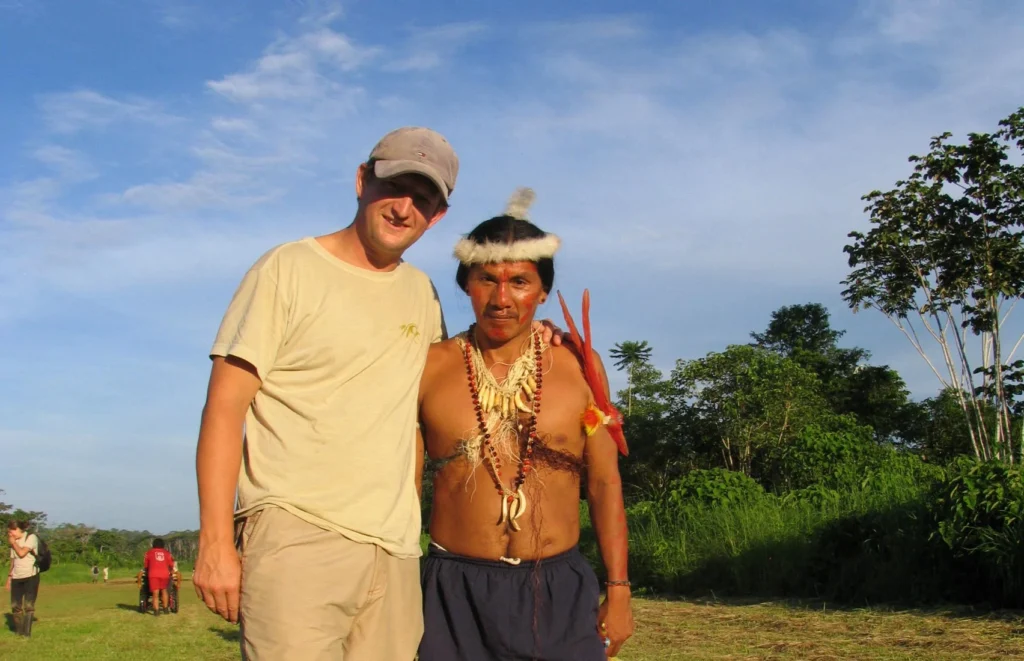
Simon: And we’ve also met—well, you came with me to the Huaorani Eco Lodge, that extraordinary joint community project in Ecuador. And I think that was either 2007 or 2013.
And I remember we got stuck in Shell for a couple of days and ate this thing called trucha for three nights. The only other option was the chontacuros that they were trying to push on us.
Simon: You have a very good memory. That’s right.
Things stand out.
Simon: But waiting for the plane to take us in…
When we did get the weather window and we were able to fly out, Simon, it was such a gift. We flew out over this ocean of green, the Amazon basin. And you think, well, Ecuador, I mean, not much compared to Brazil, compared to Peru, compared to Colombia. No, this was endless. May it stay endless, but we’re flying endlessly over a sea of green. And then we sort of slowly descended onto this tiny little airstrip. And I remember the Huaorani coming out of the trees and putting on t-shirts so we’d feel comfortable.
Simon: Yeah, that’s right. I mean, I remember that flight and it was always a case of the wonder of the endless green and may it never stop, and then as you keep heading into the endless green, a little bit of anxiety because where exactly is it that we’re going to land?
I’ve seen this movie.
Simon: Yeah. Yeah. And meeting the Huaorani, so extraordinary of people who truly have a different, truly have a different grasp on reality to us. That wonderful book which I know you’ve read back in the day, Savages by Joe Kane, New York—it was a bestseller, wasn’t it? And he gave us many examples of how the Huaorani just think differently and interact differently with their environment. But Ecuador, yeah, it’s such a wonderful country. So small compared, you know, like Costa Rica really, these are very small countries, but yet so diverse and so easy to travel around and see incredible differences in a relatively short amount of time.
Yeah, we also have been to the Chilean fjords together.
Simon: We have. We have indeed. We were down there for remote Latin America, weren’t we? Which I think was 2017.
Sounds right.
Simon: And then you and I were housemates with Nicolas and with Petit Miribel in a beautiful home in Barra Grande right before the pandemic.
Special, special times.
Simon: Yeah, we were at this incredible show in Barra Grande, which is a fairly hard-to-get-to place. And then we had this just wonderful villa with sort of water flowing through it in fountains—not through the roof, I should add, but—and these amazing views, and just a very beautiful, peaceful, serene place. And then these great friends who, coincidentally, I think it was coincidental they put us together.
That experience helped me navigate the pandemic. I traveled there in my mind many times.
Simon: It set us up just before things turned pear-shaped in 2020.
Yeah. 2019 was a year of amazing journeys actually, and then we paused for 18 months or so, and then where else have we met? So then we met…
Cuenca recently.
Simon: I was going to say—I saw you, you and Erin, on a street in Cuenca, which was about two and a bit years ago.
Yes, sir. And you invited us in. We had some kind of pastry or something when you get your coffee.
Simon: Yeah, we’ve had all these lovely little meetings and we always say we’re going to meet next time in Salt Lake City or in Brazil or in Bristol. We never quite manage it, but I think that should be our New Year’s resolution.
You and I, Gocta Natura Reserve, Northern Peru, sometime in the next 12 months.
Simon: Yeah, John, you know, I was swimming this morning at my beloved lido. It was quite cold; it activated my brain. And as I was swimming, I was thinking, right, I think later this year, we need a trip to Gocta Natura Reserve in the north of Peru to see this amazing lodge owned by the beautiful Rocío—another B Corp Lodge they are. And then possibly some archaeoastronomy around the Sacred Valley, and then maybe, who knows, maybe Lake Titicaca, but certainly I think a little trip me and you this year would be very, very welcome. And permission from the ladies, you think?
Well, we—I won’t get a pass before I take my family to Brazil in April, but once that’s in the bank, we should be able to get a pass, I think. Yes. I mean, it’s work, right, John?
Simon: It’s work. We are researching. We do have to know the places before we can have a judgment. Well, Gocta—I mean, I was—I think I mentioned to you I have not been to Chachapoyas for a very long time. In fact, around the time I met you for the very first time, I was exploring the Cordillera Blanca and then up in Chachapoyas. So, other people in my team, Nicolas has been to Gocta, but I am due, I’m due a visit. So, it would be great if we could do that together.
Yes. And you have a home outside of Paraty. This is where you go in Brazil. And if I’m not wrong, certain people can have access to that home.
Simon: Yeah, right folks. Yeah, we love Paraty. I mean, my first client, Pousada Picinguaba back in 2004, took me to that area, to Paraty and the Costa Verde, and it just blew my mind. Mountains, forests, huge peninsulas with no roads. I mean, I just fell in love with Paraty and we work with a very beautiful hotel there called Pousada Literária, which is the sister hotel of Trijun in the Cerrado and Tutabel, where I was a few months ago in Trancoso, visiting those places, and the ever-incredible Ibitipoca project as well. But yeah, Paraty does have a special place in my heart, and once a year we make our little family pilgrimage to Rio and Paraty, and then we try and visit one of Senderos‘ clients. So I’m absolutely thrilled to be going back to Cristalino in the Amazon in April and taking four-fifths of my family with me. So yeah, looking forward to that. That’s going to be really, really exciting. They’ve got some great new things happening there as well. So I’ll be reporting back when I’m back in the UK after the Brazil trip in April.
Well, Simon, it’s a pleasure always. You’re one of the real ones, one of the greats.
Simon: Oh, you’re making me smile, John. We go back a long way, me and you, and we share a love of many of the same places and many of the same people. And it’s always so good to see you and so good to talk to you. And it’s a pleasure chatting to you today.
Next time in Peru, and then in Park City.
Simon: John, I’m sending you a big hug as always. From Bristol to you, Abrazo. Thanks, Simon.