Podcast: Play in new window | Download
Subscribe: Apple Podcasts | Spotify | TuneIn
LANDED Podcast 016
CAYUGA COLLECTION & HANS PFISTER
Hans M. Pfister (that’s Mister Pfister to you!) is the co-founder of Cayuga Collection of Sustainable Luxury Hotels and Lodges.
For more than 20 years, Cayuga has guided the owners of some of Central America’s top luxury eco-lodges. His functional roles vary with the needs of each hotel. At turns, he might serve as hotel management consultant, staff counselor, financial advisor, or environmental flag-bearer.
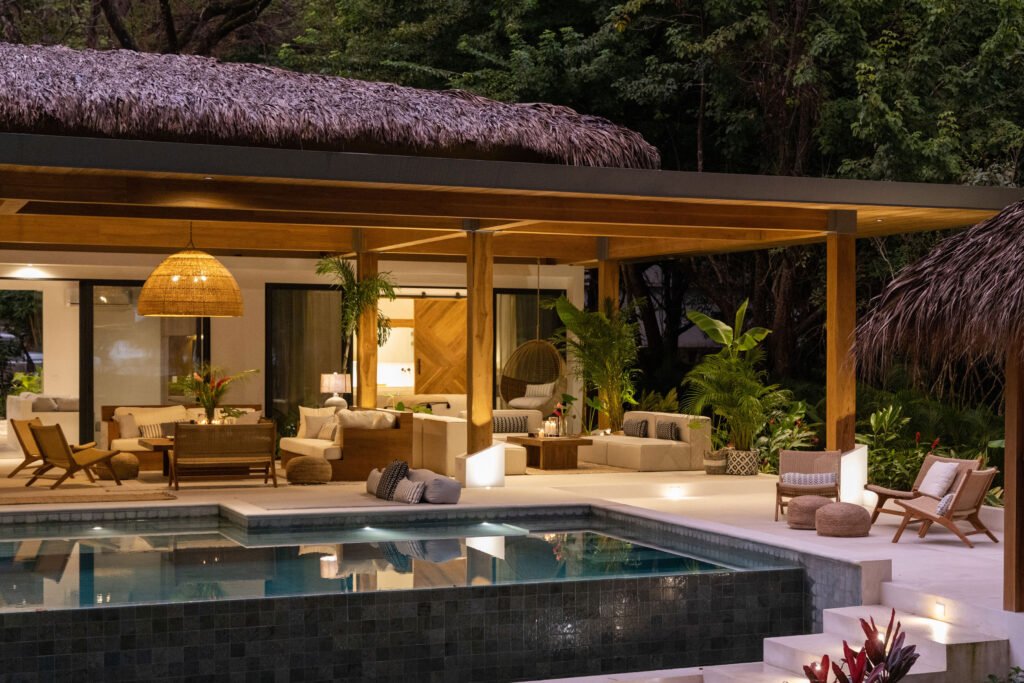
The Cayuga Collection morphs every few years as new properties join and others graduate. At present, the collection includes:
- Hotel Aguas Claras, Puerto Viejo de Limon, Costa Rica
- Isla Palenque, Golfo de Chiriqui, Panama
- Senda Monteverde, Costa Rica
- Pasha Luxury Beachfront Estate, Playa Hermosa, Santa Teresa, Costa Rica
- Arenas del Mar Beachfront and Rainforest Resort, Manuel Antonio, Costa Rica
- Kura Boutique Hotel, Uvita, Costa Rica
- Jicaro Island Ecolodge, Isletas, Lake Nicaragua, Granada, Nicaragua
- Hotel Grano de Oro, San Jose, Costa Rica
This unique collection of hotels offer year-round employment to more than 450 local staff, and protect more than 1,500 acres of Central American rainforest.
We caught up while Hans was at home in Escazu, San Jose, Costa Rica. In this conversation, we discussed the triple-bottom-line objectives of luxury eco-lodges, the role of sustainable tourism in environmental conservation, and how to tell if a hotel is greenwashing.
Hans and his wife, Jennifer Libby, are the parents of three children: Lara, Noah, and Ben. Hans visits Cayuga Collection properties every week. He loves cycling and, German that he is, he loves a good beer.
Rather read than listen?
Find the transcript below
Hans Pfister, welcome to the podcast. Thank you for your time.
Hans: Good morning, John. How are you doing?
Great. It’s a beautiful spring Saturday morning here in Utah. I think you’re in San José today.
Hans: I am outside San José in Escazú, and it’s also a beautiful morning. It’s the beginning of the green season, so we’ve had our first rains and everything is starting to get greener again, which I really like. You know, I really like the green season better than the dry season. I think a lot of locals do. A lot of people that live here really enjoy when the humidity and the moisture and the rains come back. And yeah, so life is coming back just like in the spring up north, you know, we’re having our spring, but it’s not a cold spring.
It’s a beautiful time to visit, not so crowded. What’s a nice German boy like you doing in Costa Rica?
Hans: Well, it’s a bit of a story. So, yeah, I grew up in southern Germany in the Black Forest area near the Swiss border. I always had a passion for traveling, for other countries, exploring, and for hospitality. So I did an apprenticeship—I’m sorry—at a five-star, three Michelin star hotel in the Black Forest. And my mentor there, the general manager, said, “Hey, you should go study hotel management in the United States. There’s a school that you should consider.” And so I went. So I ended up in Ithaca, New York. I went to Cornell, and that’s where I met my wife, and she’s Costa Rican. And here I am almost 30 years later.
First time I came to Costa Rica was 1994. And it’s been incredible. I mean, it really has been wonderful because I’ve been able to put my passion for hospitality, my passion for international travel living, and also sustainability to work. And so for 30 years—under the Cayuga name about 20 years—we’ve been doing sustainable luxury in hospitality.
That name Cayuga—I think you borrowed that from Ithaca.
Hans: Yeah, we brought that down. Yes, it’s Cayuga Lake, one of the Finger Lakes. And it’s funny because people think it’s something very Hispanic or Latino sounding, but it’s from the Iroquois tribe up north. So, yes, we borrowed that and we’re very thankful for the indigenous folks up north to let us use it.
20 years now, I think you’ve run Cayuga.
Hans: Next year, yes. So, Andrea is not my wife—she’s my business partner and I also met her in Ithaca. She was at Cornell with me. So, sometimes people get confused that Andrea and I are married, but we’re not. We’re business partners. My wife’s Jennifer, and she actually studied at Ithaca College on the other side of the hill.
You’ve been married 25 years, so we have that in common. Three kids.
Hans: Three kids. Twins—they’re going to be 23 this month. And a 13-year-old daughter. It keeps us young and entertained.
Well, my eldest daughter, Cora, who you helped with her senior thesis for high school, she wants to go study tourism and hospitality actually in Switzerland. So, yeah.
Hans: All right! Well, we should have a chat, see what comes of her career. I mean, it’s great to hear that because, you know, we’ve been hearing a lot about the Great Resignation in hospitality, people not wanting to go into hospitality. But to me, despite what we’ve lived through the last couple of years, it still is the best industry. The impact you can have on people, the people you meet, the places you can go and work… I wouldn’t change it for anything else.
There is a great deal of psychic income in what we do.
Hans: Yes, it’s a good way of puttin’ it.
How would you describe the mission of Cayuga?
Hans: Well, what we’re trying to do is provide our guests a luxury lodging experience that in no way does anything bad to the environment or the communities where we operate. So, we try to find that symbiosis of luxury and sustainability. You know, that’s really what we’re trying to do. We of course have other elements in there. We have a motto called “Experience, Learn, Connect, Relax.” So those are all elements that we want to put into that experience.
And I think we’re a very people-focused company. Three or four years ago, we won the Tourism for Tomorrow Award by the WTTC, right?
For the People category.
Hans: In the People category. Exactly, yeah. Ever since we started, Andrea and I were always very focused on the people. And “the people” is obviously our employees, but also our guests, the people that live in our communities, and of course also the hotel owners—our clients that we work for. Because Cayuga manages eight hotels, and there are eight different owners, right? So we’re really in a total people business. I think that’s also one of the beautiful things of the hospitality industry, but it’s also obviously a challenge. Right now, across the world, we’re seeing that if you didn’t really take care of your people, people are walking away from you, and that can be a problem.
You mentioned the nexus of luxury and sustainability. Those would seem to be competing goals. Tell us about the nexus.
Hans: Yeah, absolutely. When we first started and were working in the ecotourism space, we were really focusing on sustainability, but then also understanding that if we want to make a difference and reach the kind of decision-makers in this world that we can show sustainable hospitality to, we need to go after the luxury market. It’s those owners of companies, C-level positions, politicians, artists—if we are able to get to them and show them that there is that symbiosis of luxury and sustainability, we can make a difference. So we started to work really hard on figuring out how we can have luxury experiences without giving up sustainability.
To a certain degree, they are on opposite ends. But what we also found is that the concept of luxury can be defined in different ways. I always talk about: on the one end, it’s the Dubai-style luxury with the golden faucets and the marble counters and all that opulence. On the other hand, luxury can be waking up at 5:30 in the morning, hearing the howler monkeys, looking out on the Pacific Ocean, seeing whales playing, and scarlet macaws flying over you. That’s kind of the experience that we have been able to create at some of our hotels and lodges. So it’s more of an intelligent luxury or experiential luxury, without giving up great food, great service, really comfortable beds, and all the things that come from traditional luxury.
What we did take out a long time ago—I think now it’s 13 years—is single-use plastic. For example, I still see a lot of hotels think it’s luxury to put a plastic bottle of water in the room that comes from the other side of the world, from Fiji or Norway or France, and charge you $18 for it. In my book, that is not luxury. That’s just ridiculous. But yeah, it’s finding that intelligent luxury, that different luxury, and that actually matches quite well with sustainability. So I think we’ve gotten quite good at it, and I really feel like our guests right now are having that experience that we’re trying to create.
The term ecotourism has been misappropriated. You’ll go to an area and there will be signs that say “eco-lodge,” and you go and look at the property and what you find is that it’s very basic and it’s a lower price point, and the “eco” is really in your experience, not so much in the operation of the lodge.
Hans: Yeah, I think we’ve moved away a little bit from the term ecotourism in the past years—let’s say maybe 10 years.
Is “sustainable luxury” a better term?
Hans: Yeah, I think we use that more so. Ecotourism was defined many years ago by the International Ecotourism Society as travel to natural places that do not negatively affect the environment and help improve the community. The two parts of not damaging the environment and helping the communities—I think that’s still very alive in what we do. But going to natural places is becoming harder because even if you had come to Costa Rica 25 or 30 years ago and you come today, it’s a lot more developed. It’s not quite as natural anymore. It is still very natural and very beautiful, but to get totally away in that really remote area is every time more difficult. This is where I think it’s now more of sustainable tourism.
And your point about the very basic eco-lodge: I see those signs of eco-lodges, and I go to those places, and sometimes it’s not good because they’re simple places trying to do well. One of the things I like is that they’re often locally owned, which is a great thing. Their carbon footprint is probably pretty low because they won’t have air conditioning and other things. But on the other hand, they have to make shortcuts on maybe wastewater treatment just because they might not have the funds to do that correctly. So there’s always a bit of give-and-take on those things.
For a consumer to understand ecotourism, sustainable tourism, and all the fancy marketing terms—regenerative tourism, responsible tourism—I can understand that potential guests or travelers get really confused by all that terminology. A couple of weeks ago, I was in Austin at South by Southwest, presenting together with the Costa Rica Tourism Board on how potential guests or travelers can find out which hotels are really walking the talk and which hotels are really sustainable. Because often even certifications aren’t really helping a lot; it might actually get more confusing. It’s a complicated terminology out there, and I definitely understand that some guests get confused.
What does sustainability mean to you then?
Hans: To me personally and to us at Cayuga, sustainability really is mostly focused around people. When I talk to people that come and visit from North America, their first focus is usually on energy conservation and water conservation, and rarely about people or community. So our focus really is once again on people. I’m not saying that we’re not trying to lower our CO2 output and be as efficient as we can with water consumption and electricity consumption, but really where I think you can make the difference is in the communities and with the people.
One of the things that we are very focused on is everything local—that our suppliers are as local as possible for everything: decor, furniture, construction, and then operations, the food, and everything. Even more important: that we work with a 100% local workforce. Often when you go to luxury hospitality—
You have a chef from Europe…
Hans: Exactly! The chefs from Belgium, the general managers from… I don’t know if there’s anybody that actually lives in Belgium anymore, or if they all run hotels all over the world in Bali and—
Right.
Hans: Exactly. So I get a lot of requests—emails and LinkedIn messages—saying, “Hey, I want to move to Costa Rica. Can you give me a job as chef, general manager, whatever it is?” And I always write back to them and say, “Your resume looks amazing. I would love to hire you. My life would be so much easier if I hired you, but we have that commitment of working with local people.” And I get very nice responses back from those people. They’re like, “Wow, that’s amazing. I really congratulate you for this effort, and I310% understand.”
This is what has led us to being able to tell stories of a 17-year-old girl who walks into the hotel as a receptionist, we hire her as a receptionist, and 10 years later she’s the general manager of a world-class eco-lodge.
Or someone working in construction in Manuel Antonio ends up being the operations manager.
Hans: Exactly! I don’t know if you met Robin when you were in Arenal.
And I think about Andrey Gómez, who started out picking oranges for orange juice and ended up at another lodge that you used to have a lot of involvement with as a manager.
Hans: Exactly.
A lifting, a growing, and then a passing on of what they’ve learned to the people around them. It makes the community… it’s an inspiration.
Hans: It ties the community together and it unifies them with the lodge in a way that supports the vision of the lodge, especially on the environmental side. If I see that somebody from my social status and my educational level—which is maybe not that high—can make it up into managerial positions, that makes me want to work harder, go on that career path that we offer, take that course, or go on an exchange to another hotel to learn something new. That’s really been very powerful for us: to have people see the success of others and say, “Ah, okay, they’re not just going to hire somebody from abroad who’s going to take my job. I have a chance to move up the ladder and do that.”
You’ve had a real impact not just in Costa Rica. I know you operate properties in other countries—Panama, Nicaragua—but I’ve seen people follow your model successfully, either people that used to be in the collection that have grown, or people who are nearby and have observed what you’ve done. Your echo is greater than the size of the collection.
Hans: And that obviously is the greatest thing. If we just work in our little world, okay, good, we have an impact. But if other people get inspired to copy the model because they see that it can work and be successful, that’s the biggest praise and satisfaction we can have. You’re absolutely right: we have seen that in Nicaragua, we have seen that in Panama, and we continue to see that even in Costa Rica. People see, “Hmm, those Cayuga Collection hotels are doing really well. They’re full, they’re a financial success. Maybe we should also pay more attention to some of those people issues, community issues, and conservation issues.” So that’s a great thing, because we want to spread this and make it a movement not only in Central America, but hopefully around the world.
These are for-profit hotels. If I understand correctly, and if the work that my daughter did and the consulting you did for her was accurate, you’re looking at three bottom lines, or a triple bottom line: economic, environmental, and social.
How do you… I think I’ve heard you describe those as the three legs of a stool, that each one must be in balance.
Hans: Absolutely. We’re not an NGO. We have pressure to make ends meet. We have owners that have financial requirements that we have to meet. I always say: if you’re not financially sustainable as a business, then you’re not sustainable!
Your objectives won’t survive.
Hans: First of all, they won’t survive, because once you’re not financially sustainable, you probably have to take some shortcuts. But I also think—and we’ve had clients that were very much into just pouring money into the hotel saying, “Well, it doesn’t have to be profitable or financially successful, it’s more about the impact.” And I’m like: okay, that’s great if you’re a billionaire, but there are not that many billionaires that do that, you know? So then it’s not a model for others to follow. I do think hospitality operations need to be self-sustaining. Maybe they don’t need to have a return on investment of 30%, but at least they should be a model that others who are not super wealthy can follow and say, “Yeah, I want to do this, and I know it’s financially feasible.”
Hans, for a while, I lost interest in Costa Rica, if I’m honest. I mean, I’ve been going there not as long as you, but nearly as long as you. And there was a period when it seemed that the focus shifted from small-scale, almost democratic tourism to big resorts, mostly in Guanacaste—all-inclusive, you go in, you stay in the bubble, you never leave, you really don’t encounter Costa Rica. And I just thought, why leave San Diego? Why go to Costa Rica if you’re not going to engage, you’re not going to be experiencing what this place has to offer in terms of food and culture, and it’s an active adventure destination. How did they right the ship?
Hans: Well, I think you’re absolutely right. In certain parts of the country, there was this shift—a development that wasn’t the typical Costa Rican development. As you said, it happened mostly in Guanacaste and maybe to a certain degree in the La Fortuna / Arenal area. The more traditional sun-and-beach vacation is flying into Liberia (the other airport), spending a week at the beach, and maybe going to Arenal. Statistics by the tourism board show that tourists flying into Liberia up north in Guanacaste spend less money, spend less time in the country, and the tourism dollar is not distributed as democratically as in the rest of the country.
There’s a big difference with tourists flying into San José and then heading inland, heading south, or heading to the Caribbean coast. I really believe most of the country still has that democratic concept where the tourism dollar gets distributed: people staying in several smaller hotels, going out for dinner, hiring local guides, going on tours, maybe driving on their own, stopping and buying something in the supermarket, or taking local transportation. So I hear you, but I think the model is very much intact; it just got pushed a little bit to the side in Guanacaste. And I have to say, there are a few hotels in Guanacaste that still maintain that traditional model as well.
It just seemed to be a developmental focus change. And it is true. I mean, we were just at Aguas Claras, and it was wonderful on the Caribbean side of the country to have a meal or two at the hotel, but then grab a bike and go into Puerto Viejo, find a guy who’s making craft chocolate, have dinner, talk with locals on the beach, or just walk and enjoy the environment. It’s the opposite of the bubble.
Hans: Yes, totally! Aguas Claras in Puerto Viejo is a great example. When you head south of Manuel Antonio towards Uvita, the Osa Peninsula—those areas—you can certainly still have those kinds of experiences. Even Monteverde or some of the mountainous destinations offer a very authentic, different experience. So Costa Rica is still very much that destination; you just have to be careful that you don’t end up in a branded all-inclusive resort in Guanacaste, because then you’d obviously be very disappointed.
Small-scale lodges—there is a sort of sweet spot. A lot of your lodges have, what would you say, 15 rooms or fewer?
Hans: It’s quite a mix. The smallest one is eight rooms—that’s Kura up in the mountains of Uvita. The only reason why that is feasible is because of the really high rates, like above $1,000 a night. That’s the only way such a small place can be financially feasible. Then we go up to 28 or 38 rooms for Senda in Monteverde and Arenal Manoa / Manuel Antonio, and those are much easier to make ends meet.
Aguas Claras, which we just talked about in Puerto Viejo, has 13 rooms. That’s just a little not quite enough. We’re getting there, but we actually just had a meeting with architects out there, and there’s a space where we can maybe add one or two more of those Caribbean-style casitas. If we go up to 15, I think then we’re closer to that sweet spot. So if somebody comes to me and says, “I have land. I want to develop a small boutique sustainable hotel or lodge,” I typically don’t go under 15 rooms because it’s just so hard to make the financials work. If it can go up to 20, 22, 25 because the land can take it, then that would be ideal.
I’ve heard you describe tourism as being a little like fire. And I think what you mean by that is that it’s a useful tool, and we appreciate the things that it can do, but if it’s unmanaged, if it goes wild, it can do a lot of damage.
Hans: Absolutely, yeah. We’ve seen that around the world and in Costa Rica: tourism can do a lot of good to communities, to people, to incomes, and also to conservation. A lot of the places that I go back to today, almost 30 years after I first came to Costa Rica, the wildlife and the forests are in better shape than they were 25 or 30 years ago. When I first came to Costa Rica, the scarlet macaw was really only seen on the Osa Peninsula; you could hardly see it anywhere else. By now, you can see it almost all along the Pacific coast all the way up to Guanacaste. And one of the great things is that the great green macaw, which was really close to extinction, can be seen all over Puerto Viejo and the southern Caribbean coast all the way up to Tortuguero.
Those reintroduction programs were financed by tourists visiting those places and paying a fee to learn about the project, which kept them going. However, when it gets out of hand, that fire can do damage in different ways. One is overtourism—too many people at the same time in one place, infrastructure breaks down, and social structures in communities break down.
Something else I’m seeing right now in places like Santa Teresa and Nosara is that incredible wealth comes in—billionaires investing, and all of a sudden inflation drives prices rogue. What normally would be a reasonable price for a meal or rent is no longer affordable to locals. I guess you call it gentrification. We’ve seen some of that during the pandemic with digital nomads moving there. So the fire can go both ways: it’s either too hot and too intense with too much money driving locals out, or it’s too widespread with negative impacts on the community.
But overall, we’re able to harness the fire in a very positive way in Costa Rica, Nicaragua, and Panama, and the benefits still outweigh the downfalls. We saw that during the pandemic when tourism stopped—it was tough on communities and tough on natural habitats, because people had to resort to poaching or cutting trees to survive. When tourism came back, that stopped again.
What advice would you give to travelers who want to limit their environmental impact or use their time and treasure to improve the environment or local communities?
Hans: I wrote a blog post on “How can we come back better after the pandemic?” There are a few things you can do as a traveler:
- Don’t travel during the peak season: Travel during the shoulder season. It’s a much better experience—you’re not standing in line, you can actually find rooms, and you’re taking pressure off those communities. It helps us keep our commitment to our staff to employ them year-round, rather than hiring seasonally and firing them in the low season.
- Spread your tourism dollar democratically: Don’t stay inside a walled all-inclusive resort. Go from place to place, travel in between, stop on the way, hire local guides, eat at local restaurants, and get a feel for the country. Or skip across the border into Panama or Nicaragua to experience another culture and history.
- Stay longer: Don’t take 10 long weekend trips if possible. When you spend the CO2 of air travel, make it count. Spend more time exploring the destination deeply.
- Look beyond the ‘everybody goes there’ destinations: Instead of just going to Papagayo and Arenal, try getting off the beaten track to places like Puerto Viejo on the Caribbean coast, Uvita and the Whale’s Tail in the south, or Monteverde. Ask yourself: what are the destinations that are not quite as busy, but just as beautiful and offer a better experience?
Two of my favorite places in Costa Rica don’t have very good hotels. I wish you would work with someone to get us something in Sarapiquí, and I would love to see something in San Gerardo de Dota.
Hans: Yeah, you’re right! These are very special little gems that not many people visit. Well, maybe I’ll write it down and inspire somebody to invest!
Talk to my daughter about this! You seem happy. You find a lot of meaning in the work that you do.
Hans: Totally. It’s never hard to get out of bed in the morning because I know I can make a difference every day. It comes back to the people—seeing their growth, how they excel, innovate, and deliver incredible experiences to our guests, take courses, become managers, or start their own businesses. I travel across Costa Rica, Panama, and Nicaragua and run into people who worked for us and say, “Thank you for teaching me.”
A couple of months ago, my son was kayaking in Golfo Dulce with college friends, and the guide said, “Oh, you’re Hans’s son! I worked for three or four years at the lodge they used to manage here, and I couldn’t have started my own business without that learning.” That’s where my happiness comes from—knowing I can really make a difference.
You always go back to the people.
Hans: I always go back to the people because we’re a people business!
I have found as a parent, employer, or coach that taking untapped or undeveloped talent and helping it reach its full potential is the most rewarding thing.
Hans: I agree. And I’m also happy that I’m still around and still have a business! Two years ago at the beginning of April 2020, I wasn’t so sure where we were going to be. I was considering moving back into my parents’ basement because things were looking really bad. So when you’ve seen that abyss of where tourism was two years ago and you’re able to come back out of it stronger and better than ever, that makes you happy.
What are some of your favorite hotels in Central America?
Hans: Good question. I can’t really afford to stay at the kind of hotels that I manage! Sometimes I visit other hoteliers and we give each other great rates. In the pandemic, I came across Origins Lodge in Bijagua—a small six-room lodge plus a villa overlooking Lake Nicaragua near the border. I went there coming out of the pandemic, worn out from fighting for survival. I loved that it was small and intimate, and the rooms have outdoor wooden jacuzzis heated by a campfire system with coils. Sitting in that jacuzzi looking out at the lake gave me a lot of strength to carry on.
But really, as a hotelier, staying at a hotel is important, but getting out, doing activities, exploring, and being outdoors is what makes the difference when you travel.
Are there places you’ve visited abroad—in Morocco or the Maldives—where you thought, “They’re doing something really smart here, I need to bring that back”?
Hans: Yes. Through National Geographic Unique Lodging of the World (where we used to have three lodges before the program stopped), I made a lot of friends. Three Camels Lodge in Mongolia is a place I’m dying to visit. I sent a couple of my managers to Tierra Hotels in Chile, which they absolutely loved.
In the Maldives, I stayed at Soneva Fushi and really enjoyed their organic vegetable garden program—it was mind-blowing! I was inspired to bring that back to Costa Rica, but when you’re on an island in the Indian Ocean, you’re not competing with the most biodiverse ecosystem on Earth with all these animals and insects. Doing agriculture in the rainforest meant we were constantly competing with iguanas, birds, and animals for the food! So that wasn’t as successful, but there’s a lot out there that I admire.
You’ve made it through the pandemic and had a great influence on hospitality and community development throughout Central America. What’s next for you?
Hans: We’re still shaking off the dust from the battle, but there are a couple of things we’re looking at. With Pasha in Santa Teresa, we started in a different market: managing a 10-bedroom beachfront luxury home with a 12- to 13-person year-round staff. We welcomed our first guests in December, and there’s a very strong market for luxury homes managed with our level of service and sustainability.
We also visited the Dominican Republic late last year—some of the most beautiful beaches I’ve seen in my life—so maybe we can bring our model to the Dominican Republic as well. But expansion in moderation: making sure whatever project joins the Cayuga Collection is aligned with our values and part of the positive impact of fire.
Hans, there are moments from my travels in Costa Rica that come back to me that are precious to me. Any moments you’d share that would help explain the spirit of your adopted country?
Hans: Two months ago, I hiked the highest mountain in the country, Chirripó (about 3,800 meters high), for the second time, with my 22-year-old twin sons. We hiked up early at 4:00 a.m., saw the sunrise over the Caribbean coast, while a full moon was setting over the Pacific coast. It was 2°C, and we were wearing winter clothes—an experience you wouldn’t normally associate with Costa Rica! Then we hiked down, had breakfast, drove to Dominical, and within 10 hours went from the top of Costa Rica to soaking our sore muscles in the warm Pacific Ocean.
Another time, with a couple of journalists, we started at Kura early in the morning, planted trees to offset our carbon footprint, and took a charter flight directly to Limón on the Caribbean coast. Waking up on the Pacific coast and having lunch on the Caribbean coast—that incredible variety of mountains to beach, coast to coast, and all the microclimates—it’s a privilege to live here.
Are there any misconceptions about Costa Rica you would dispel?
Hans: A lot of people think: “Costa Rica is in Latin America, therefore it must be cheap.” Costa Rica is not cheap! The cost of living is high for those of us who live here. But you have to see that it’s a stable, democratic country with a large middle class, good healthcare, safety, and cleanliness—and that has a cost. It’s the Switzerland of Central America!
Well, Hans, thank you. You’ve been very generous with your time, both with me and with my daughter, helping her with her thesis. It’s great to catch up.
Hans: Thank you, John, for your interest in Cayuga and for visiting us, and I hope we see each other again sometime soon.
Thank you. Best to you.