Podcast: Play in new window | Download
Subscribe: Apple Podcasts | Spotify | TuneIn
LANDED Podcast 007
ENRICHING LIVES AND THE ENVIRONMENT–LUZ & ROBERTO: BOENA LODGES
Luz Cacares and Roberto Fernandez make the most out of life. When we visited them for this interview, we spent the day hiking in the private rainforest reserve at Lapa Rios, on Costa Rica’s Osa Peninsula. Simultaneously, they were directing operations at four hotels, working with education and conservation foundations, and rebuilding the riverside restaurant at Pacuare Lodge.
Luz and Roberto are the husband and wife team behind Boena—a collection of iconic wilderness lodges in Costa Rica that harness the power of leisure travel for conservation.
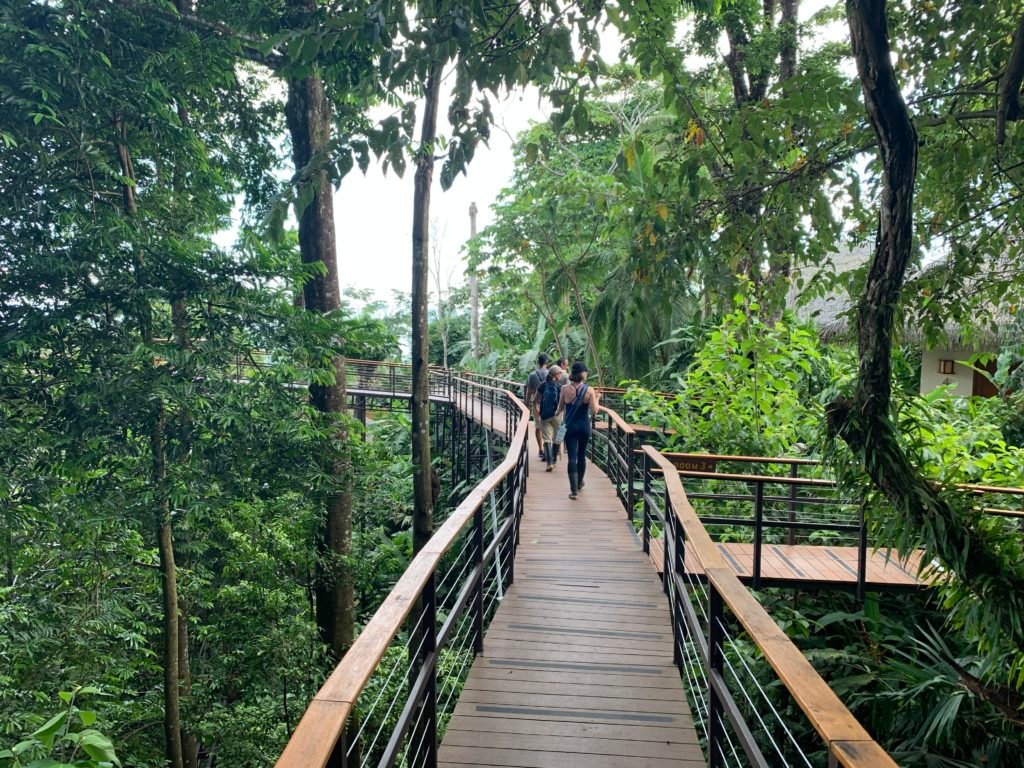
Luz and Roberto are pioneers in eco-tourism; they’ve been part of the conservation landscape since 1986. Roberto started his rafting company, Aventuras Naturales, on the Pacuare River near Turrialba in 1986. Pacuare Lodge opened in 1996. They acquired Lapa Rios in 2020. With Boena, they’ve expanded their influence into Monteverde and Tortuguero. Boena’s five guiding principles are: untouched paradise, nature is luxury, life-changing adventure, rejuvenating indulgence, and authentic human connection.
As they put it, “We exist so that the paradises where we operate will be there forever, for the enjoyment and wonder of generations to come.” That’s not just marketing. They live by that code.
With some background noise from macaws and toucans, our conversation with Luz Cacares and Roberto Fernandez.




Luz: Hi, how are you, John? Nice to have you here with us.
Roberto: Hola, John. It’s been such a beautiful experience meeting you and Erin. We’re so happy to meet you and happy to have you here at Lapa Rios in this incredible and amazing place.
Yeah, it’s great to finally meet you. I was able to spend some time with Luz in Barbados a few years ago, but it’s great to finally meet you, Roberto.
Roberto: Yeah! You know, we feel so blessed getting to know people like you. That’s probably one of the most beautiful things about tourism—when you meet people and make those relationships, connecting with each other no matter where you live. That’s part of the ecosystem.
Well, you’ve been connecting people and doing that in tourism for many years now—decades now.
Roberto: Yeah, for more than 30 years.
Luz: More than 30 years.
You are both… well, you’re not both from Turrialba, but you met in Turrialba.
Roberto: Yeah, we met in Turrialba. I was born in Turrialba and I lived in Turrialba until I was 20-something, when I started the company. That was the beginning of moving into the Central Valley in San José. But Luz grew up in Turrialba as well.
Luz: Yes. My parents are from Colombia. So in the ’60s they had the opportunity to come from Colombia and live in Turrialba. So it was a big change for them—first time for my mother leaving the country, and for my dad as well. So actually, I was born in San José, but immediately went back to Turrialba because my dad was working at CATIE, which is a tropical center where they study tropical crops, and I grew up there until I was 11 years old. So I was really inspired by the beauty of Turrialba. And then later, when I was working in the travel business, I had the blessing to meet Roberto, and that’s where the love story started.
Roberto: So yeah, growing up in Turrialba is part of our lives and who we are, because Turrialba was like a playground for both of us. We grew up in the middle of rivers, lots of space outdoors, volcanoes, jungle, and waterfalls. So our lives were attached and connected to nature, and that’s why we’re so happy doing what we do right now.
So you’ve owned Pacuare Lodge. You developed that from inception. When did the lodge open?
Roberto: Well, at Pacuare Lodge… first time, if I go back a little bit, I went to Pacuare as a kayaker maybe 35 years ago or something like that. I just fell in love with the river. I said, “This is it. My life is going to change after this.” Because discovering Pacuare was something very touching and connected to my heart. After that—I was studying agriculture and biotechnology in Turrialba—I said, “I’m going to start my own business, my own rafting company.” And that was the beginning. At those times we were doing just overnight trips camping on the Pacuare.
Yeah, but since the beginning you wanted to build a lodge, and that was your dream. Five years later you got the chance to open Pacuare Lodge, so already about 30 years ago.
It started as a base, right? Just for Aventuras Naturales. You were just storing some gear there. I think you talked to the landowner, and then it evolved into a shed and then buying the land. Is that right?
Roberto: Yes. We were renting a piece of land in the middle of nowhere in Pacuare. But that was something interesting because the money that we were giving to the guy living there, he was using that money to buy more cows and bring cattle to an area that is meant for forest! So we were doing something very wrong. I was always looking for a way to buy the property, and we ended up buying it. At the beginning it was just 30 acres—a small piece—but over the years we had the chance to buy more land. So right now we have almost 800 acres of protected rainforest, most of it primary forest. For us, it’s such a blessing.
So primary forest has never been cut. Secondary forest is second growth after it’s been cut. But here in Osa, this is a lot of secondary forest, but some of the trees here that were never cut—well, they’re cathedrals, as you said today.
Luz: Yes, actually. Like we were talking this morning, when you see the Osa where Lapa Rios is located, 30 years back it was mostly pastureland surrounded by cattle ranchers. Seeing it 30 years later, it’s amazing how the forest recovered. So ecotourism has really been a key element for conservation in the area. Today we did this hike and you were able to experience one of the trails and see how the dynamic works. There were some trees that are 100 years old, probably some 500 years old, mixed with secondary forest that is restoring itself. The restoration is amazing.
Roberto: What you see here is a miracle of life. You see how everything regenerates in such a short time. That’s spectacular.
You get to watch creation happen.
Roberto: Exactly.
The forest has a memory, and it comes back quickly when we leave it alone. It’s not like you’re planting trees here; they’re planting themselves.
Roberto: Yes.
Pacuare is a little different, though. You were planting trees there. I think you had a tree planting program, but it got a little out of control.
Luz: Yes! Actually, we used to have this “Plant a Tree” program. Guests really loved it, but it came to the point where Roberto said to us, “No more trees!”
Roberto: We were planting a problem! There were so many trees that it was going to be a whole jungle right in the middle of the bungalows. Fortunately, it was a happy problem! We had to cancel the program because it was already so covered with forest and trees.
But both of the lodges operate primarily on renewable resources, right?
Roberto: 100% of the energy comes from solar and water. We have an amount of water that allows us to produce a lot of energy, plus the sun. So we have that mix of energy that gives us the opportunity to be off the grid, which is really nice.
So, Pacuare Lodge… if you’ve not been, you maybe spend the night in San José—that’s probably the easiest way—or in Turrialba, and then you raft in on the Pacuare River. It’s probably about an hour or an hour and a half on the initial stretch. Many people stay three nights or two nights at Pacuare Lodge. What would you say is average?
Luz: In the beginning it was more like one night, but when we added more activities in the area and more comfort—beautiful villas—guests opted to stay more nights. Nowadays it’s about three nights on average, because our package includes nine different activities included, so there’s plenty of things to do.
And these are soft adventure, but also cultural, right? Because you’re right next to the Cabécar community.
Roberto: Yeah, that’s probably the only place in Costa Rica where you combine nature, adventure, and culture with the indigenous community. And you don’t have to leave the property to experience those amazing activities. Still after 30 years, we are always discovering new things.
And the Cabécar community—many of them are your employees too, is that true?
Luz: Yes! Nowadays we have a team of about 12 members of the Cabécar community. They walk about an hour every day to the lodge because they want to stay living with their family clans. We are very happy to have them on staff; they add so much to the experience. We’re even training two Cabécar members to be naturalist guides. It’s a great way for them to tell the story of their community and culture, while knowing the rainforest so intimately.
They’re good neighbors. You’ve had a little trouble with some of the other neighbors in the past, right? With some of the local towns where there was poaching in the past, but you’ve developed programs that helped curtail and stop poaching for future generations. How was that accomplished?
Roberto: The river divides the area in two. On our side, we have the indigenous community and half a million hectares of rainforest—the largest protected area in Central America, going from the tallest peak in Costa Rica all the way down to the Caribbean and Panama.
Is it contiguous with La Amistad?
Roberto: Yeah, it goes all the way down to La Amistad, up to Chirripó mountain, and down to Tortuguero. It’s probably the most important wildlife corridor in the country. On the other side of the river, we have small tico towns where years back we had issues with poachers hunting for bushmeat. It was kind of a traditional culture for them passed down from grandfathers.
Luz: They were even trafficking wildlife.
Roberto: So it took us a few years to come up with an idea, and the first one was hiring the best poacher in the area!
To hire them! As guides or security?
Roberto: Gerardo, who was the best poacher in the area… I said, “Gerardo, I want you to come and work with me, and you’re going to be my right hand.” He was like, “What? But I am your enemy!” I said, “No, you’re not my enemy. What you do is what I don’t like, but you are a guy with a lot of talent, so I want you to work with me.” It was impressive! He became an engineer of sorts taking care of our whole canopy zip-line structure, moving platforms, and calculating heights.
For all your canopy tour zip-lines!
Roberto: Yes! We sent Gerardo to Monteverde to get trained, and they told me, “That guy is natural! The knowledge he has of trees and the forest is incredible.” Without formal math, he did amazing calculations. He became a really important person. That was a huge shift in his life. After 30 years working with us, he is now retired with a beautiful house, and his son Luis is working with us as a naturalist guide!
That’s great.
Roberto: That was one way we got rid of poaching. The second idea was going into primary schools to talk to the kids about the benefits of ecotourism, protecting wildlife, water resources, and managing waste. It’s a program running for more than 10 years where we plant seeds in their minds and hearts.
So Pacuare Lodge has really grown up. It was originally just five cabins, and now you have 20 luxury villas. How many families are you employing at Pacuare?
Roberto: In normal times, about 90 families.
Wow. So after staying at Pacuare, you raft out through narrow canyons with fantastic rapids, ending near Siquirres. And these lessons you learned at Pacuare, you applied to your next adventure at Lapa Rios. Lapa Rios was originally started by John and Karen Lewis.
Luz: Yes, the Lewis family.
I think we first came here in 2006 with our kids. What are some of the changes you’ve made here since acquiring it in 2019?
Roberto: The first step was getting rid of the diesel generator! We installed solar and hydro technology to make Lapa Rios 100% renewable and off-the-grid.
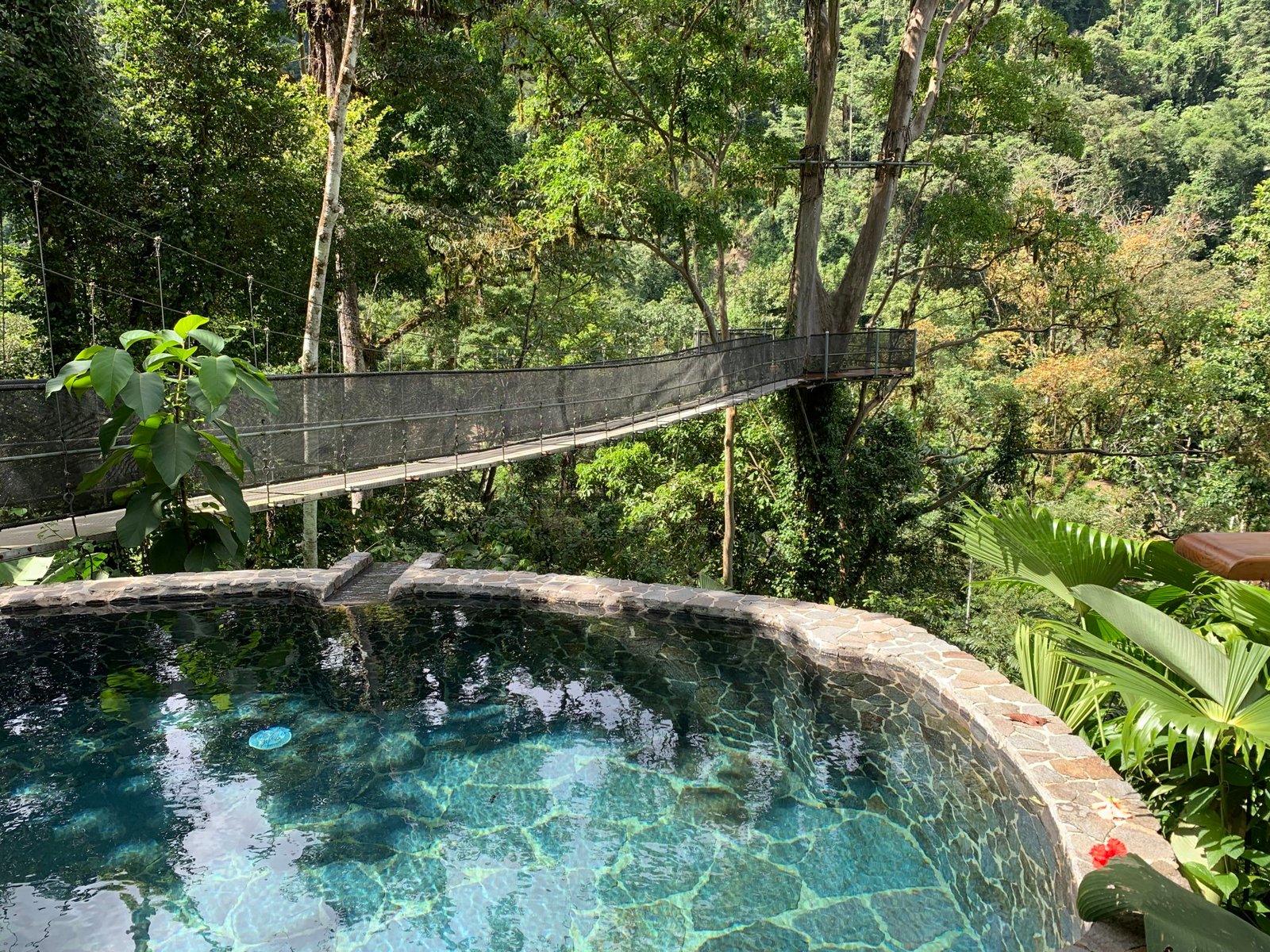
Luz: Then we upgraded the facilities and built six new spacious villas with private plunge pools, expansive decks facing the Golfo Dulce and jungle, where you can watch sunrises while listening to howler monkeys, squirrel monkeys, scarlet macaws, and toucans flying outside your villa.
The wildlife at Lapa Rios is so habituated, but they don’t cross the line or beg for food.
Roberto: They are very active and happy eating fruits from the surrounding trees.
And these lessons learned allowed you to rebrand to Böëna Wilderness Lodges, which now includes Pacuare Lodge, Lapa Rios, Monteverde Lodge, and Tortuga Lodge in Tortuguero.
Luz: Yes! Böëna in the Cabécar indigenous language means “wellness” or a greeting like Pura Vida or Aloha. We wanted to honor the Cabécar culture where everything started for us.
So a guest could start at Pacuare, raft out, travel to Tortuga Lodge in Tortuguero, head to Arenal, continue to Monteverde, and then fly down to Puerto Jiménez for Lapa Rios in one of the most biodiverse places on Earth. What’s next for Böëna?
Roberto: Next, we have a beautiful property in the Arenal area where we want to create a lodge from scratch. And we are also looking at the Pan Dulce beach area right next to Lapa Rios to build some beautiful oceanfront villas.
It’s really special what you’ve put together. Thank you so much for the hike and for your hospitality!
Luz: Thank you so much for spending time with us, John!
Roberto: It’s my pleasure. Thank you!